


 de
de  fr
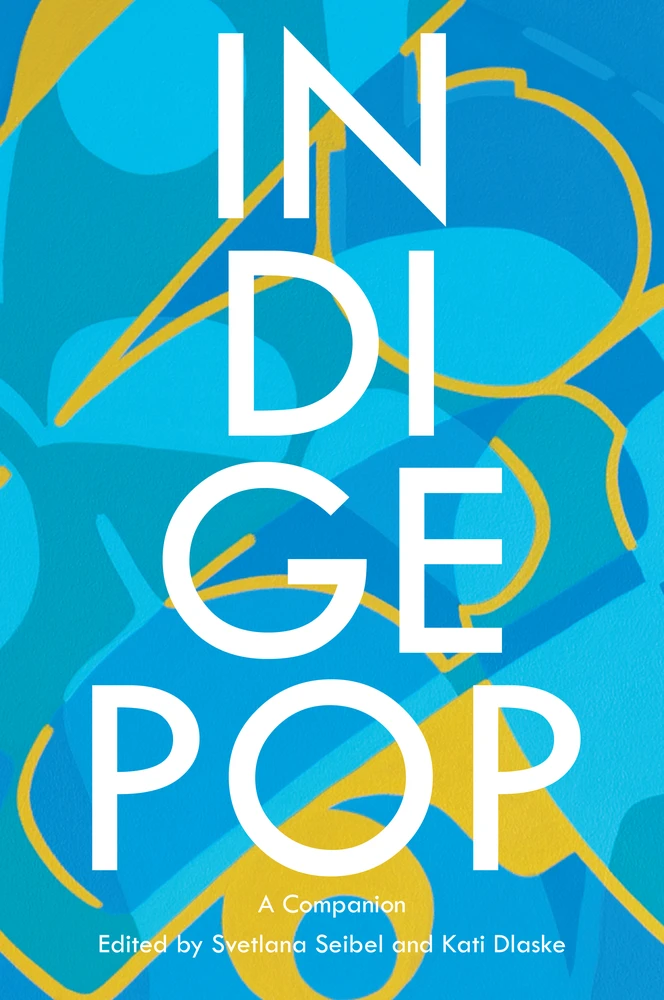
fr Having fun is a serious business. IndigePop: A Companion, an edited collection published in December 2024 by Peter Lang, makes this point as it explores the dynamic and multifaceted field of contemporary Indigenous popular culture. Indigenous popular culture celebrates the Indigenous popular and Indigenous nerdy creativity in all their manifestations, gaining increasing momentum since the turn of the twenty-first century. The contributions in the book offer a range of perspectives on the Indigenous popular by scholars, artists and practitioners who work with and in the field of Indigenous popular culture in various capacities, from different standpoints, and in a range of geopolitical contexts. The origins of the book go back to the Indigenous Comic Con 2, which took place in Albuquerque, New Mexico, in November 2017, and which we had the privilege of attending. There we had a chance to speak to participants and organizers, who generously shared their perspectives on the event and on Indigenous popular culture with us. These conversations and experiences inform the book in many significant ways.
Popular culture moves fast. As we were working on the book, Indigenous popular culture continued its dynamic expansion, going from strength to strength. Dr. Lee Francis 4 (Pueblo of Laguna), the founder of the Indigenous Comic Con and the Executive Director of Native Realities who contributed to IndigePop in more ways than one, is at the center of many of the initiatives in the field, both old and new. We had a chance to interview him at the Indigenous Comic Con back in 2017, and we were delighted and honored when he agreed to speak to us about the state of the art of Indigenous popular culture on the threshold of 2025. His remarks give insights into the latest developments and milestones of Indigenous popular culture, and also situate the book in its larger context.
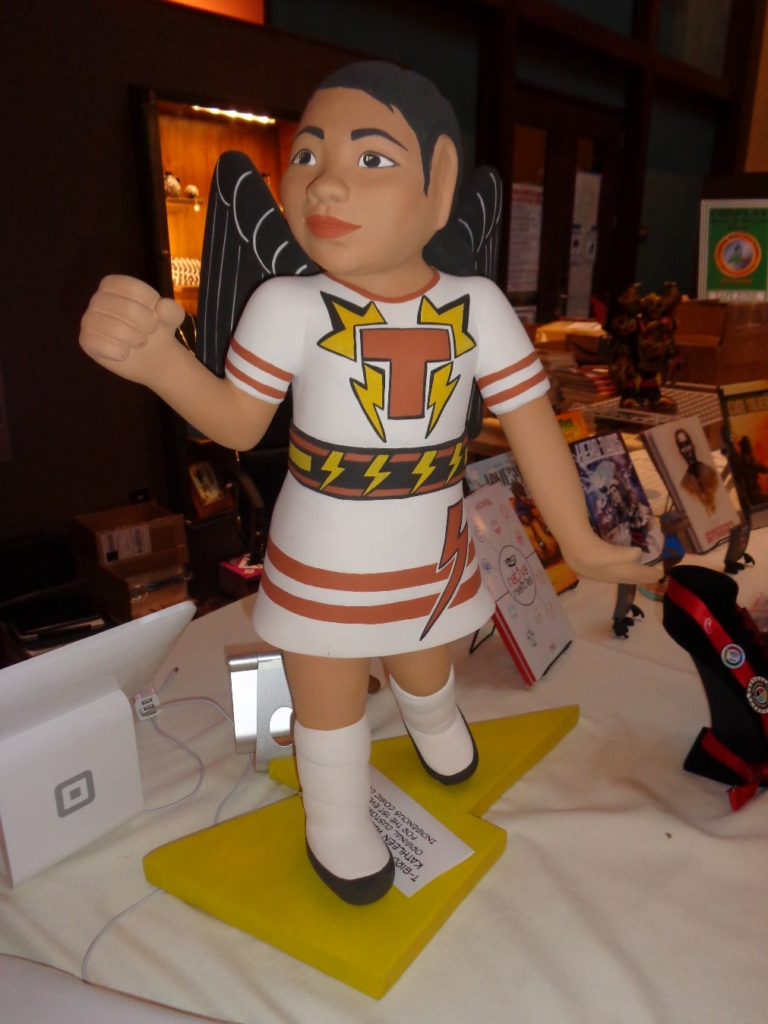
Interview with Dr. Lee Francis 4
12 December 2024, Zoom
*The interview is slightly edited for clarity and readability.
SVETLANA
During our interview back then [in 2017] we asked you about the development of Indigenous pop culture at the time, and where it was at the time. Seven years have passed now – almost exactly, it was November – so, which significant trends and developments have taken place since, in your view? What is the current status of Indigenous pop culture?
LEE
Yeah. When we got started… And I mean, we gotta go back a little bit too, because when I first started working with comics that was 2012, and there was this sort of emerging… There were some folks that were working on things, but really not a lot – there was this small group, the Indigenous Narratives Collective, there was Arigon Starr’s work and John Proudstar and the initial folks that we were working with. And really all the way for that first four years, up until about 2016 when we launched the first Comic Con, there wasn’t… you know, there were people that were really sort of scattered, doing small things. And I think what that first event did was really put a lot of names into the public sphere. And so, what we’ve seen in these last seven years, from 2017 on, is really this explosion of Indigenous pop culture creativity. So you see a lot of folks that have been a part of the comic cons – the IPX and Indigenous Comic Con moving forward – you’ve seen a lot of them just taking off on the work that they have, the collaborations that they’ve contributed to, a lot of the folks that were a part of those initial comic book works that we did, we’re seeing a lot of their work now into the mainstream. You know, just in that time period we’ve seen the rise of a lot more Native television, a lot more Native cinema – so, Prey came out on Hulu; you saw Reservation Dogs, of course, and the work that they did with that; you see the Marvel stuff, you see Echo and you see Kahhori from the What If…? series getting her own comic now. So, you’re seeing a lot of these developments that weren’t really present seven years ago, so I think, really, the biggest impact that we had was putting all of that work front and center and really allowing people to find those people online. I still get folks, but definitely within those three initial years people were contacting us, being like, “Who are your guests? Who are your vendors? We wanna find more artists,” with people coming out to interview and put together projects based on the people that we were working with and collaborating with. So, I think that’s really what we’ve seen, is just this explosion of talent. And now you have all these kids’ books that are out, and you still have more mass media that’s come out – they did the Marvel Indigenous Voices [in 2020], and they’re still releasing pieces of that, those are all people that were really a part of the first inception of this, first couple of years.
SVETLANA
And when you look at all these developments, are there any milestones that you think were particularly influential?
LEE
Yeah, the release of Reservation Dogs – that was, like, three years ago, four years ago – I think that was hugely influential. I think the Marvel Indigenous Voices was hugely influential. So, I think those two were really putting folks into these mainstream conversations and pop culture conversations. I mean, Sterlin Harjo won the McArthur Fellowship within this last year. So, that is what we’re seeing. And then you see the cartoons and the kids’ stuff that’s come out, and Spirit Rangers was another milestone, so you have a kids’ cartoon on Netflix. So I think those are these big moments, but I even think just… obviously, continuing on with the Comic Con, with Pop Culture X, the stuff that we’ve done, now we’re seeing more of those – so, SkasdiCon in Oklahoma, Cherokee Nation; the áyA Con in Denver; these other Native-centered, Native-specific conventions where people are, like, yeah, we still want people to come together, we still wanna have these moments where we can do this kind of work and these collaborative, amazing creative spaces. I think those are still a lot of the great milestones that we’ve had.
SVETLANA
Yeah. I guess the first Comic Con remains this watershed moment for Indigenous pop culture, right?
LEE
Yeah. Yeah. I think 2016 really set a lot of things in motion. And looking back on it, in building careers, connecting up with folks, I think that really… it was so unique, it’s something that I feel was so needed, and continues to be needed, that I was just… I’m always stoked to have founded it and been influential in continuing its success.
SVETLANA
So, it did impact – and change, you could say, also – Indigenous pop culture, right?
LEE
I absolutely believe it did, yeah. I mean, you’ll have to check in with other folks, but for me I think there is a definite change from this moment.
KATI
You talked about this a little bit already, but if you look at the bigger picture, so how do you think, or do you think that the Indigenous Comic Con has had an impact or influence on the popular culture at large?
LEE
I think it gave Native folks, Indigenous folks a space to be able to showcase their talent, and in a different way that wasn’t tied to previous notions of what is Indigenous art. And I still think that that’s the impact. The impact is allowing Native creatives permission, you know – because they know there is a space where they’re gonna be welcomed for doing things that are avant-garde, for doing things that are not conforming to what the Americanized ideal of… the American mythology of Native art, Native identity is supposed to look like. So, you still have cosplay, you still have comic books, you still have these reappropriations of mainstream – or Indiginizations of mainstream pop culture things that Native folks are still grabbing onto and claiming as their own. So, I think it’s still really about the creatives, and I think that that’s the part that has been the longest lasting impact.
KATI
If you think, then, a little bit the other way around, do you think Indigenous representation in mainstream popular culture is improving?
LEE
I think… yeah, slowly, very slowly. You know, when I talk about this, I’m, like, this is four hundred years of Natives in pop culture, and I continue to write about this, this liminal space that Native folks occupy – you still see it. I mean, every year we have to put out, you know, please don’t dress up for Halloween, Natives are not a costume. So, there’s not been this overnight shift, but you’re seeing a lot more in the conversation of folks that are wanting to be much more authentic, much more deliberate in their ways that they’re framing – especially artistically – the ways that they’re writing about or framing Native identity and Native folks and being much more specific about it. There’s still a long way to go, you still see a lot of the same tropes that show up, and it is one of the dilemmas… in any type of identity markers, the dilemma is how do you showcase that in a visual way, so the people understand that that person comes from this particular heritage. With Native folks, because it’s so specific, there are so many cultural tropes, stereotypes, but also touchpoints, because of the interchange of ideas, because of the interchange of art throughout histories and time immemorial, that’s the balance that still continues on, especially as a Native artist. So, how do we recognize that a character or somebody we put out there is Native without certain markings, without certain pieces to that? So, there’s still a balance in that [that] I think is always gonna be a struggle, because our identity has been dictated to us for four hundred years, and we’ve just… I mean, it’s been within two generations, three generations that we’ve been reclaiming it – in mass media, in popular media.
KATI
Yeah, yeah. The Indigenous Comic Con took place in North America, and many of the developments that we’ve been talking about had been taking place in North America as well. So, if you think in more global terms, how do you see Indigenous popular culture globally, developing on a more global scale?
LEE
There’s so much great work that’s going [on]… So, it exists sort of in two frames. I think you definitely see the idea of the Native American as a global concept, and so that’s still something that we’re trying to change those perceptions, because… I think that because it was American pop culture spreading everywhere you still have these entrenched views of what Native America is. For global Indigeneity, I think you’re still looking at an evolving terminology around how we’re codifying what does that mean. So, in some of my travels – obviously, we hosted a Comic Con in 2019 in Australia, and so talking about that, seeing what folks have been doing down there, and my colleague that was the host for that event [Cienan Muir] continues talking about Indigenous Australian identity and what does that mean for their popular culture. Because they have a different set of movies and films, and identity, but you can see things – I think one of the movies down there that was really solid… or it was a TV show, called Cleverman, and that was going on in 2017, I believe, and that was an Indigenous person with superpowers, and what they were doing with that. Now, that didn’t make it this direction, but it was something that was internal. You see the same thing with our Māori relations in New Zealand, they’re making comics and they’re putting things forward. So, I think a lot of this is using this medium, this pop culture spheres to be able to address the ways in which representation has been detrimental to Indigenous communities. And I think that that’s what we’re seeing globally – a lot of it having to do with digital access, and the ease with which you can put a lot of this forward.
KATI
We’ve been talking about the recent developments in the past years now, but there are certainly many exciting developments in Indigenous popular culture ahead. So, what is the vision going forward? Are there any specific new initiatives you would like to mention?
LEE
Yeah. This next year we’re going to be here on the East Coast, so we’ll be out here in North Carolina, so focusing some attention out here to our East Coast relatives, because, again, this concept of Indigenous identity is very Western-oriented. And so, wanting to continue the conversation and allow for Native creatives that are Eastern relations to be able to showcase their work as well, and inspire them to be a part of some of that stuff. So that’s one of the big things that I’ve been working on the last couple of years, really trying to get a lot of this work grounded on the East Coast and being able to tell more of these Eastern stories. I think that we’re doing a lot around world building. The new organization that we’ve brought everything under these last years is called the Indigenous Imagination Workshop, so the idea is how we’re cultivating a lot of these concepts coming from these places of fantasy and science fiction and Indigenous futurisms, how are we now applying that in our own communities. Like, what do we want for these fantastical worlds? If we have these superpowers, what do we do with them? How do we make our communities better? And then, how do we actualize that, that’s the inspiration to spark the imagination. So, I’m working on a piece right now that talks about this intersection of generational trauma, and intergenerational trauma, and its effects on the imagination. And so, what does that look like when you have… or doom and imagination, right? We can see all the terrible things, but we have continued to survive, and thrive in many ways, and so how does that look when you’re having to deal with trauma, ‘cause trauma creates roadblocks for imagining. So, how do we work through those and utilize pop culture and utilize these spaces to spark that imagination in our next generations?
SVETLANA
And one last question maybe. I was thinking about the importance – and we stressed it in the book as well – the importance of the celebratory aspect of Indigenous popular culture, the celebration and the having fun. So, I was wondering whether you have any thoughts on that.
LEE
I think it still comes down to celebration, right? Like, how do we have moments of joy? Even within the framing… I mean, everything is always political, but it’s this… I think the counterpoint in pop culture that still holds true, what we have available to us is to find ways to celebrate our identity, our continued exitance, without fetishizing tragedy. Because that’s been the perpetual narrative, it’s about fetishizing Native tragedy – everything [that] happened, look at the poor…, you know, look how terrible everything is for them. And so, the celebration, also, it’s celebration of resistance, celebration of empowerment. Celebration, I believe, gives you agency, and gives people the chance to… when you can celebrate, in moments, then you are able to more effectively dictate the terms through which you are going to navigate a colonial/postcolonial society.
SVETLANA
Yeah, very true. Thank you so very much, this was great! Thank you for your time, and for doing this.
Dr. Lee Francis 4, aka Dr. IndigiNerd, is the CEO of A Tribe Called Geek (ATCG) Media and the Executive Director of Native Realities, both of which are dedicated to creating pop culture media that celebrates Indigenous identity. He is the founder of the Indigenous Comic Con and an award-winning editor of over a dozen comic books and graphic novels. Lee has won accolades for his work on Ghost River, Sixkiller and Native New York. You can find more about his work on social media @dr_ indiginerd. He lives in North Carolina with his family.
At this point in the 21st century, it is difficult to talk about the oceans without immediately thinking of what mankind has done to them — micro-fibers, raw sewage, oil and chemical pollution, over-fishing, rising temperatures and sea levels — threatening and destroying not just the lives and habitats of sea creatures, but also our own. Yet films like Meg 2: The Trench (Wheatley: 2023) want to make us forget that through the deflection of scale. For who can think about the overwhelming size of the environmental crisis when confronted by a 60+-ft prehistoric shark? Failing that, it makes us want to believe that nature can somehow protect itself — not from us, of course, but those greedy billionaires and corporations (the mega-sharks of the capitalist world) that seek to exploit the planet for their personal gain rather than ours.
Much of the above is achieved through the attribution of blame and the identification of who or what is good and bad in the film. Obviously its star, Jason Statham, is necessarily good and in a manly, but sensitive way. Nature, of course, should also be good, although this is complicated by being an area beyond human knowledge or control. The film takes this further, showing it not just as a place beyond our reach, but beyond our time, as well: it literally symbolises an ecological Eden where knowledge of value and exploitation has never reached … until now. It is worth looking at this underwater idyl more closely because it is represented as a kind of “magical kingdom”, a world so far removed from our own that it could be a completely different planet — indeed, the echoes of films like Avatar and Avatar: The Way of Water (Cameron: 2009 & 2022) and its “nature spirit” are explicitly there.
Of course, Meg 2 reminds us it is our planet by the conceit of prehistoric creatures still living there, as the trench has not only been protected from us but from the passing of time itself. In many senses,this is the environment that time forgot and where nature has been left to take care of itself.
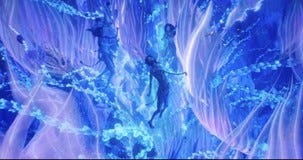
But now, humans have arrived and brought capitalism with them and punctured the temporal bubble around this idyllic landscape of the past so that time can flood in … while they suck the mineral wealth out of it. Nature, if we go with its connections to Avatar, is not happy about this and so releases the megalodons, and assorted other beasts, to both protect it and seek revenge on those who have dared to enter its domain.
This mirrors the scenarios from both Avatar films, where human exploitation causes the planetary spirit to instruct its creatures to actively attack and kill the human interlopers. As such, the megalodons, or Megs, should be the good guys, as they are acting on behalf of the earth — not unlike the common cold in H. G. Welles’ The War of the Worlds (1898). Yet two things work against them: first is their size, which oddly translates to making all the oceans of the world instantly dangerous. This is established at the start of the film when we see a Tyrannosaurus Rex being eaten by a Meg in a few feet of water, suggesting all seawater is now deadly. This can also be read as the Meg itself representing pollution, not least in its scale and voracity, making the entirety of the oceans a source of deadly danger to humanity. Second, the Megs have a connection to the past and symbolise a world before (without) humans. This deadly temporal anomaly is at the heart of the Jurassic Park franchise, but the Meg instantly situates itself as far more dangerous when we saw the Tyrannosaurus Rex being eaten at the start of the film[1]. This clash of the past and the present gets more interesting since the director of Meg 2, Ben Wheatley, is arguably best known for his Folk Horror films Kill List (2011) and A Field in England (2013), and transposing the characteristics of such films onto this film yields some curious results.
If we read Meg 2 as a Folk Horror film, many of the plot points work surprisingly well. To begin, we have an isolated landscape/environment — the trench — that is separate from the modern world. It has its own skewed belief system, where nature rules over itself and is made manifest in its “rulers”, the megaladons. We then have the intrusion of the modern world into this isolated place, in the shape of the mining company, which becomes a catalyst for the events that follow. Usually in Folk Horror this involves some form of ritual or “summoning” of the old gods, and in many ways this can be seen to be fulfilled by the megalodons and the other Eldritch horrors released: like the devilish beast brought forth from nature in Blood on Satan’s Claw (Haggard: 1971) or the one being called upon at the end of The Wicker Man (Hardy: 1973). What also happens in Folk Horror is often the sacrifice of a hero of sorts, the one who tries to defend the modern world and its belief systems — Sergeant Howie in The Wicker Man, for example — but is inevitably sacrificed and “consumed” to power the continued presence of the ancient (natural) past in the present. Of course, our “Sergent Howie” in Meg 2 can only be our hero Jonas Taylor (Jason Statham), though there is no way that he can be sacrificed to the “gods” of the past at the film’s end with the possibility of another sequel in the works. That leaves our Folk Horror reading at a bit of an unfulfilled impasse.
Perhaps a better reference point is the 1970s and the “animal revenge” films that evolved from Jaws (Spielberg: 1975). Movies like Jaws, Grizzly (Girdler: 1976), Tentacles (Assonitis: 1977), and Nightwing (Hiller: 1979), etc. all feature a human hero (inevitably a man) that saves the day, even in the face of corrupt officials and money-grabbing corporations. Yet, they tend to be Everyman-type figures, often thrown into the situation and doing their job or the best they can to save family, friends, or those they feel responsible for. Statham is slightly different in that he is far more of a professional “hero”. For all the pretense in the film of him being down-to-earth he is not only a specialist, and built like he is from a special forces unit, his cinematic pedigree positions him as superhuman. If Sergeant Howie was unlikable and clueless in the face of his “enemy”, we already believe that Statham can beat a 70-ton shark with his bare hands.

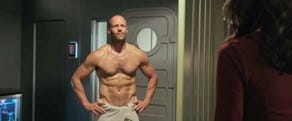
Statham can save us from the dark forces of nature — even while it embodies a world before pollution — and even from the “jaws” of the corporate sharks that look to consume both us and the environment we depend on. Of more concern, though, is that Statham is not “one of us”, as the heroes of the 1970s natural horror often were. Instead, he is a savior who saves the world for us, so that we do not need to do anything and can carry on partying at the beach — coincidently, beach scenes appear in both Meg films. This is perhaps the most worrying aspect of a film that, through size and scale, purposely tries to deflect us away from its core message that, in the face of the world’s oceans becoming deadly places to be in, or even near, we do not need to do anything but can relax on our beach chairs and watch the show of a single hero saving us all. In the face of the mega-shark of impending environmental catastrophe, this is possibly the most dangerous thing we can do.
[1] The importance of size in the Meg (Turtletaub: 2018) is explored in Craig Ian Mann’s essay in The Deep: A Companion (2023).
The Deep: A Companion is now available here: https://www.peterlang.com/document/1339843
A (S)Mothering Inheritance in an Age of Precarity, or, We’re Too Removed from the World to Ever Be in It
This blog post will look at two films, Hereditary (2018) by Ari Aster and Incantation (2022) by Kevin Ko. On the surface they seem very different from each other, with Aster’s film being labelled as “elevated” horror, with a very thoughtful and aestheticized approach to set design, camera work and pacing, while Ko’s relies heavily on a found-footage aesthetic, frenetic action and continual jump scares. In many senses, they serve as examples of the opposing poles of recent horror, one concentrating on a more intellectual and artistic approach (Hereditary) and the other being very referential to the wider genre and often dependent on many sudden shocks and scares (Incantation).
However, while both share elements often attributed to the Folk Horror subgenre — plots involving non-majority religious cults and rural settings — this article will argue they share a far deeper connection through what we might call an “undead heritage” that is focused around a maternal figure. This can seen to be linked to the more well-known ideas of a family curse or “the sins of the fathers/mothers”, although strong male figures are largely absent in both films. This theme has very specific connotations in the twenty-first century that are strongly indicative of the “age of precarity” we are currently experiencing in the 2020s and our inability to protect our futures.
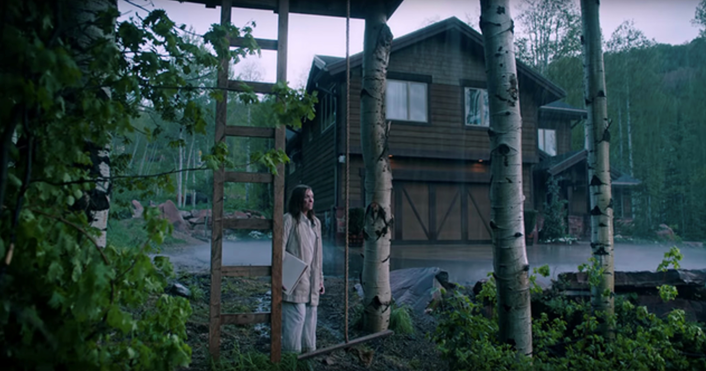
“Undead”, here, as more fully explored in The Undead in the 21st Century: A Companion, signifies an entity that is neither dead nor alive — even beyond life and death, in some way — and driven by an insatiable desire to consume, or find sustenance in, humanity. In both these films, this “undeadness” is manifested in a god-like, supernatural entity that is outside human conceptions of life and death — effectively immortal in most senses of the word — and which is compelled to draw the life from humanity,[1] and, more specifically, humans linked by family bonds, using a ritual of some kind (this often requires the recitation of a text that “invites” the undead entity “in” and consequently “curses” the recitee). Curses or undead language is of note in each film as the person being cursed does not need to know what they’re saying, but the performative nature of the recitation acts as an invitation to the undead entity.
This idea of unknowing is important for the undead heritage theme, as it often belies an inability of the present — as embodied in the victim — to understand the meaning of the past that is often in plain sight. The victims inevitably only understand the meaning of the “clues” of the past when it is too late and they are about to be consumed by their undead heritage (a common theme in Folk Horror). Indeed, unknowingness plays a large part in many forms of precarity, particularly in relation to contemporary ecological and political environments.
Before looking at the films more closely, it should be mentioned that the two narratives look at undead heritage slightly differently and, cultural specificity aside, also point to a slightly different view of the world in 2022 than in pre-pandemic 2018.

Hereditary features Annie (Toni Collette), who is grieving the recent death of her mother. Their relationship in life was extremely problematic, even abusive, and although Annie is surrounded by both physical and psychological memories of her mother’s past, she prefers to reconstruct the present to try to understand her increasing sense of foreboding. On top of this, her daughter, Charlie (Milly Shapiro) is decapitated in a freak accident involving Peter (Alex Wolff), her son and Charlie’s brother. Annie meets Joan (Ann Dowd) at a bereavement group and she admits to her she had “given” Charlie to her mother as a placatory measure, but it had left her even more excluded from both of their lives. Indeed, Annie appears deeply removed both from the feminine heritage of her own family (her mother and her daughter) and the world around her, and the lifelike models she makes are attempts to control and place herself in her environment.
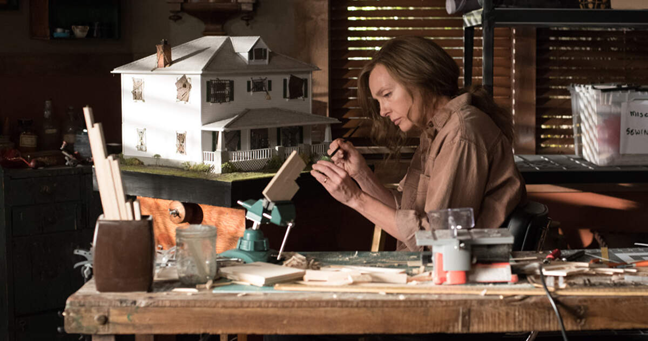
Joan gets increasingly close to her and reveals that she has managed to contact the dead and can show Annie how to do it, too. Annie then performs the ritual as described to her by Joan, importantly reciting a verse of a language she doesn’t understand, and forcing her husband and son to do so with her. This effectively invites the demon king Paimon into the human world, allowing him to possess the body of her son and kill all those that are not supplicants to his power. It seems that Annie’s mother was a high priestess who had linked Paimon to the “soul” of Charlie, who should have been born a boy, and now wants to inhabit Peter. It is only at this point, once her undead heritage has overtaken her, that Annie realizes what is occurring and that the clues were all around her in her mother’s belongings: Joan is in her mother’s photos of occult rituals, and highlighted passages in her copies of esoteric books all point toward worship of Paimon and inviting him into the world through the body of a boy.[2]

It also gives further meaning to the distance from her own children and her subconscious attempts to kill them — in not killing them, she has effectively ended the world as we know it. Overwhelmed by her undead heritage and her inability to protect her family or herself, Annie loses her grip on reality, her identity and literally, her head, as Paimon possesses the body of Peter and becomes manifest. Exactly what Paimon intends is not made clear, though one suspects it will add to the precarity of a world already out of balance, though one that neither Annie or her family will be part of.
Incantation focuses on Ruo-nan (Hsuan-yen Tsai), whose life is a frantic pastiche of flashbacks and ragged camera footage as she tries to hold on to the present and envision a future for her young daughter. The curse she now carries is not her own but one that she stumbled upon, bringing the undead heritage of others into her own familial lineage. Some time ago, Ruo-nan and a group of “Ghostbuster” friends went to the ancestral village in rural Taiwan of one of their number. The villagers and the friend’s relations told them to leave as a special and potentially dangerous ritual was being performed, but the rebellious friends stayed, interrupting the ceremony and breaking into the shrine, despite all the warnings they were repeatedly given.

Not all the friends escape, as some unseen power overtakes them and Ruo-nan, who unbeknownst to herself was pregnant, was forced to recite a “blessing” while placing her hands in a special configuration. Deeply affected by the events, Ruo-nan gives up her child and only many years later feels strong enough to reclaim her from those caring for her. It is only at this point that her undead heritage begins to catch up with her and she soon realizes that it’s been passed on to her daughter. Now that the curse is starting to affect her life, she decides to investigate further to understand what she and her friends had done and pieces together what the past actually means for her daughter’s future.
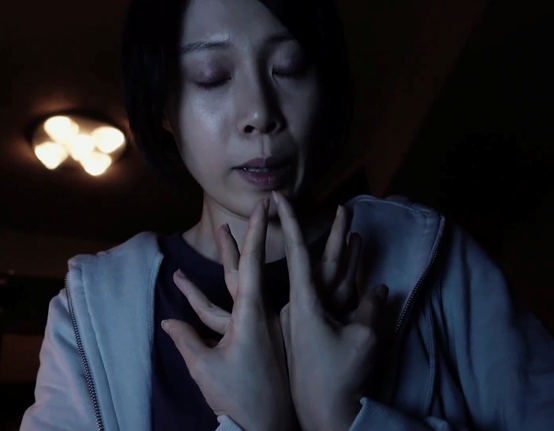
The curse seems to take the form of ever-increasing precarity as Ruo-Nan’s actions become progressively frantic and her life spins out of her control.
It transpires that the village worshiped a malevolent deity and that the “blessing” — which takes the form of a multi-syllabic phrase — is in fact a curse, that when repeated invites it into your life and slowly kills you. Ruo-nan’s daughter, Dodo (Sin-ting Huang), even after following the advice of local religious healers, is getting increasingly worse, so she goes back to the village, the past, to undo the present. However, once there, she goes into the depths of the underground shrine to confront the image of the deity and realizes that once the curse, the undead heritage, has been invited in, it cannot be revoked but only lessened through sharing.

Ruo-nan then ends the film as it started, as she has done at various points throughout the narrative, inviting us the audience to recite the inverted blessing so that we might share the curse and lessen its affects on her daughter. Here, then, Ruo-nan’s gradual understanding of the undead heritage she has released mirrors our own, as we realize that the phrase we have been asked to recite has cursed us: Ruo-Nan’s daughter might live, but we could be forgoing our own futures to make that happen.
Both films show maternal figures that discover too late that they have unknowingly become imbricated into an undead heritage that will cost them their children and, by implication, any kind of future. In Hereditary, ignoring of the signs of the past is almost wilful in Annie’s pursuit of an understanding of a world that she feels she is central to, when in fact she constantly contrives to remove herself from it and, consequently, any meaningful possibility of intervention. This can be read, in a pre-Covid world, as a humanity too involved in itself to understand the true meaning of its past or of its place within it, and that understanding will only occur when it is too late to do anything about it. Ruo-nan from Incantation, was similarly too self-absorbed to realize what she and her friends were getting themselves into or the nature of the undead heritage they were inviting into their lives. However, the curse here is far more virulent in nature and, once invited into the environment beyond the village, spreads its curse without restraint — as also seen in films like The Ring franchise (1995–2022), and the Ju On franchise (2000–20), which also often feature maternal protagonists. Equally, then, Ruo-nan, like Annie before her, has lost her children/child and a possible future through not understanding the past or the nature of the undead heritage she has become part of. What is slightly different in Incantation and, I would argue makes it more of a “pandemic” film, is her willingness to “spread” the curse to others in an attempt to save her child. There is no sense of acceptance that one has transgressed the past and a price must be paid, rather it moves the focus on alleviating one’s own problems regardless of the costs to others.
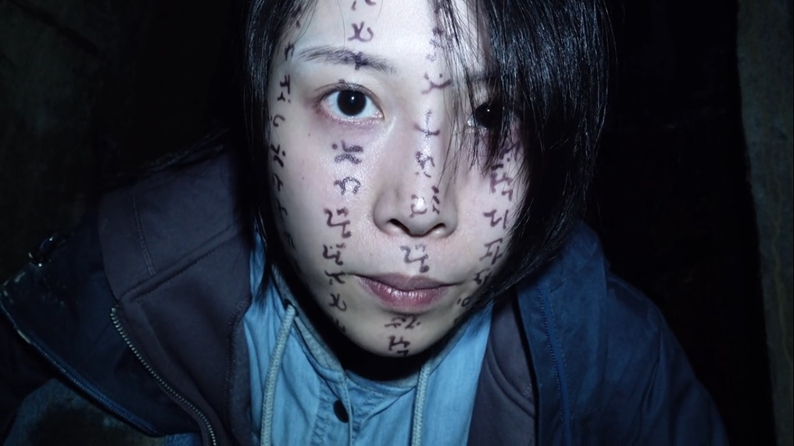
Ruo-nan’s selfish act seems to resonate with much in the present predicament of humanity, which seems to wilfully ignore the clues from the past that tell of modes of damage and exploitation that have blighted our environment and our intercultural relations, continuing to deny any responsibility and, consequently, inviting the curse of an undead heritage that will inevitably consume us. Of particular note is the growing sense that we are no longer in this together and that individual actors are increasingly focused on saving themselves or their own. Annie’s self-absorption might have exacerbated her predicament and allowed for an undead heritage to be visited upon the world, but Ruo-nan, even though she won’t be there herself, is willing to risk the world for her daughter’s future. A seemingly noble endeavour, but one that purposely endangers humanity itself.
Simon Bacon, author of The Undead in the 21st Century: A Companion and series editor, Genre Fiction and Film Companions
[1] There is much here that confirms to fantasy author Terry Pratchett’s idea that gods of any kind require human belief to remain alive, though in horror texts this has been extended to supplication, dreams and fear amongst other human emotions.
[2]Films like the Paranormal Activity franchise (2007–21) work on similar themes. I would like to thank the members of the SCMS Scholarly Horror Group on FB for their help and thoughts regarding the possible implications of the ending of Hereditary.
Toxic environments would seem to be a given in horror films, and the creation and representation of spaces from which terror and violence can suddenly emerge are an inherent part of the genre. However, the nature and texture — or, what we might call, context and characteristics — of that environment are necessarily linked to the specific cultural moment from which they emerge. One of our current greatest anxieties — spawned most recently by images of the fleeing refugees from Ukraine — is immigration or, more particularly, the experience of being an outsider. This brief blog post looks at three recent horror, or horror-adjacent, films that can be seen to explore this very particular 21st-century anxiety, though one that is arguably as old as the creation of human societies.
The idea of “home” and the tensions between “not home” and “unhome” are central to the texture of the toxic environments under discussion here. The immigrant experience as seen in horror films is one that often focuses on the intersection between “home” and “toxic”, where what is considered as home becomes toxic in some way — domestic violence, extreme poverty, or war — and so then becomes “not-home,” forcing them to leave and try to find a new home, or as is often the case a new “not-home”, but one that is less toxic — physically or psychologically dangerous — than their original home. Horror film, which is often the perfect medium for effectively representing the anxiety around the sudden changing of safe environments into extremely threatening ones, is well suited for narratives describing the alienation or out-of-placeness that immigrants feel in a new country. This in itself is a characteristic of more recent films on the topic and, unlike popular or populist discourse, does not solely focus on the dangers of outsiders but rather the danger faced by those deemed as outsiders.
In the case of the three films discussed here, the outsiders/immigrants depicted are themselves very contextual, in that the nationality of the immigrants carries a very weighted meaning in their host country (a very similar weightedness is seen more recently when contrasting Syrian immigrants arriving in Europe with those from Ukraine, for instance). In this sense, the immigrants depicted in each film are those that are less welcome than others and are arriving into an environment that is already made toxic by pre-existing nationalist cultural narratives that do not recognise them as individuals in need of help but instead as a xenophobic threat. Horror films take a particular approach to representing these tensions and anxieties, as opposed to more realist or documentary style narratives, as they are inherently expected to manifest psychological monstrosity in physical form, and this is clearly seen in the examples chosen below.
The three films chosen — Mum & Dad (Sheil: 2008), His House (Weekes: 2020), and No One Gets Out Alive (Minghini: 2021) — feature immigrants from Poland, Africa and Mexico, respectively, entering the UK and/or the US at times when a very particular stigma surrounded such moves. Each film takes great pains to speak to the cultural context and the specific texture of the toxic environment the protagonists find themselves in and how they might survive it.
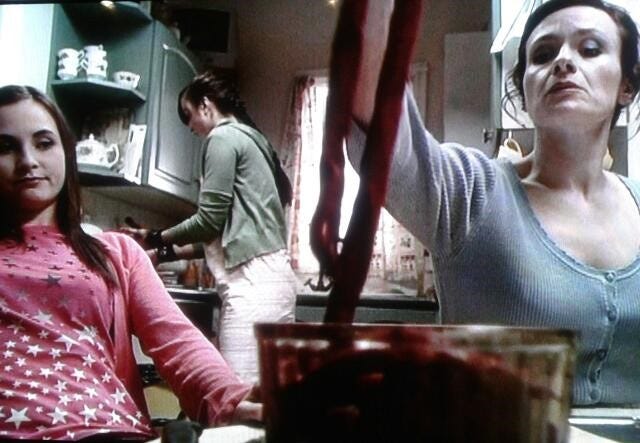
Mum & Dad focuses on Lena (Olga Fedori), who has just arrived at Heathrow Airport in the hope of finding work and a better life than she had in Poland. The airport itself becomes symbolic of an environment she has no connection to, and she herself is depicted as a commodity (baggage) moving through it and prey to anyone that might claim her. A worker at the airport offers to help, finding a bond in their shared exploitation, but she turns out to be a decoy who takes the girl to her “parents”, who turn out be brutal captors who thrust her into a toxic world. The “traditional” British home shown is one so extreme as to be the equivalent of a house of horrors: the television continually plays porn, they brutalise and handicap their “children”, and they celebrate Christmas with a real crucified man with a tinsel crown. Here, the alienness of other cultures becomes the stuff of nightmares, creating a toxic environment that leaves Natalia changed forever, even though she manages to escape. With no recourse to the authorities, or money to return home, she is left the victim of a culture that violently insists on changing her and seeing her solely as a commodity to be used and disposed off once it no longer has any need for her.
His House sees Bol (Sopi Dirisu) and his wife Rial (Wunmi Mosaku) arrive in the UK from South Sudan, a nation in conflict and consequently wracked with poverty, drought and starvation. They enter into an immigration system that only begrudgingly helps them, moving them to a house in an area that does not welcome them. The toxicity of the system and environment around them seems to concentrate in their new “home,” which seems alive with malevolence against them. Here, though, the nature of Bol’s relationship to his former home, which seems to have decidedly become not-home, is seen to link directly to the toxicity of the environment where they now live. They had pretended someone else’s child was their own to escape and now the child is dead. The guilt of their actions in South Sudan and the ghost, or “apeth”, they brought with them resonates with the dilapidated nature of the house such that it seems the structure itself is marking it out as not-their-home, just like the government immigration system. This toxicity, though, is eventually diffused through a level of acceptance of their guilt for their actions in their former home — the resolution tying Bol and his wife more closely together — so that their current one, whilst not exactly becoming “homely”, is less not-home than it was before. Here as a family in a toxic environment they find a form of home within themselves, if not with the environment around them.

No One Gets Out Alive focuses on Ambar (Christina Rodlo), a Mexican immigrant illegally living in the US. Her mother has died and the poverty of her home drives her to find a new life in America. However, her relations that already live there want little to do with her, leaving her to struggle to find underpaid work and cheap lodgings to stay in — even one of her workmates swindles her out of what money she has. The toxicity of the city-scape she finds herself in translates poverty, hunger and job precarity into a gothic-laden lodging house run by middle-aged brothers that cater solely for immigrants. Ambar is quickly assailed by anxiety, apparitions and threats of physical violence. This escalates into actual violence as it transpires the brothers are feeding the untraceable and uncared for lodgers to an entity in the basement.
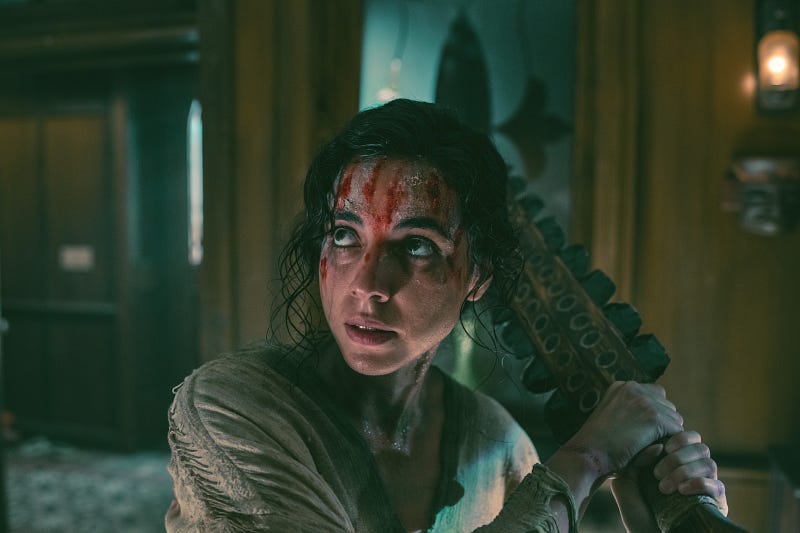
The denouement here, as with Mum & Dad, reveals the extreme violence of the immigrant experience in the face of the unknown traditions of a different culture yet, as with His House, for Ambar some of this is tempered by a reckoning with previous guilt related to her former “home” and an equally violent reaction against the alien culture to retain her own sense of self. Within this there is also a sense that she finds some points of connection to the alien culture via the entity in the basement, which is also an immigrant of sorts. Here then she establishes a different kind of “home”, where its toxicity becomes her own, or at least one that she understands more clearly now. As the film ends, Ambar has become reconciled with this new “not-home,” and not unlike Lena and Bol has been forced to readjust both her sense of self and what she considers “home” in light of her experiences.
The three films point to the inherent nature of a world moving ever more towards large-scale displacements for reasons of poverty, war or environmental disaster and where “not home” will become increasingly common for ever greater numbers of people. Horror might be able to show us how scary the sometimes toxic environment of “not-home” is for others and also highlight the importance of finding points of commonality between ours and others’ ideas of “home.”
Simon Bacon is the editor of the forthcoming collection Toxic Cultures: A Companion in the Genre Fiction and Film Companions series, for which he is also the series editor.
Note: Many thanks to the members of the SCMS Horror Studies Scholarly Interest Group on Facebook for their suggestions for similarly themed films and in helping to define the term “not-home”.
One might not naturally think of a disease as a transmedia narrative, let alone the centre of a multi-platform universe, yet by their very nature they move across media, from the individual to the social, from word of mouth to social media, from fact to fiction. Historically these transmedia outbreaks are made sense of after the fact, usually once data has been collected and interpreted. The Covid-19 pandemic is a little different in that not only is there constant access to a huge amount of information that is increasing daily, but it also has a narrative template through which this is being read.
This template, or ‘outbreak narrative’, is one that has been constructed between reality and fictional representation, in books and films, to create a narrative arc of contagion, one which has a start, a middle and an end, but also one which inherently creates a transmedia story-world around it that both explains and supports that arc. This short blog will lay out how this works in the current pandemic and how its narrative world is supported by earlier outbreaks, both real and fictional, yet is simultaneously working against its own successful completion, creating the possibility of a story that will never, truly end.
Priscilla Ward (2008) has described how, around the HIV/AIDS pandemic of the 1980s, certain narratives arose to explain the disease that were part science, part media reportage, part cultural imaginings. In many ways it describes a transmedia migration at its most fundamental, where bodily manifestations and oral accounts are recorded and interpreted, adapted for newspapers, news programmes and the popular imaginary, creating a kind of ongoing dialogue between actual events and cultural, fictional representations of them. Films, in particular, have played an important part in this process, presenting complex information in a form that is accessible (simplified) and culturally comprehensible — this equally skews or omits parts of the truth to fit existing cultural templates and preferences. This created a pandemic narrative that featured proscribed stages and tropes: 1) a disease originating in an undeveloped part of the world, often involving monkeys or bats, caused by human incursion into the animals’ natural habitat; 2) a ‘patient zero’, often combined with the idea of a ‘super spreader’; civilisation becomes aware of the outbreak, enforcing ‘contact tracing’ and ‘quarantine’; 3) a race against time to develop a vaccine; 4) and, finally, administering the vaccine and returning to ‘normality’.
A good example of how this narrative was used and affirmed in film and fed back to the popular imagination is Outbreak (Peterson: 1995), which follows much of the above template: a deadly virus from Africa (modelled on the HIV/AIDS epidemic); animals are involved; there is a ‘patient zero’, quarantine, contact tracing, a vaccine and a race to save humanity. Steven Soderbergh’s Contagion (2011) builds on and reinterprets the narrative world of Outbreak and has become the definitive film on the subject in the current pandemic. Originally released after SARS (2003) and Swine flu (2009–10), the film interprets what the world had just experienced, emphasising and adding new parts to the existing narrative.
The film begins with the outbreak already in progress with the designated ‘patient zero’, Beth Emhoff (Gwyneth Paltrow), flying back from Hong Kong, infecting people as she goes. Beth is shown as an unfaithful wife who meets an ex-lover on her journey, linking the narrative to that of the earlier AIDS epidemic, which was popularly associated with transgressive sex.
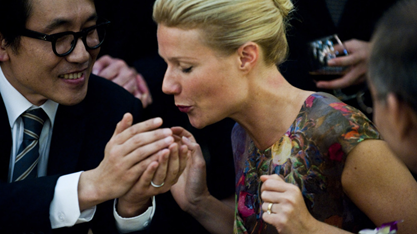
As the world (America) begins to realise that an outbreak is occurring, the investigative stage of the narrative begins, involving contact tracing and the search for the point of origin — a temporal and media movement that embodies what Jenkins calls ‘spreadability’ (2013), in some ways is a natural component of contagion. The outbreak narrative then crosses various media platforms (news media, tv, radio, social media and word of mouth) as well as crossing borders, becoming transmedial and transnational, as researchers follow its path back to where it started. Once contact tracing has begun and the severity of the outbreak has gained greater understanding, the fight for survival begins, which also has two parts: the first is quarantine and containment and the second is producing a cure (vaccine). The former then requires that the ‘readers’ or ‘players’ of the narrative comply with the instructions they are given, which also relies on the coherence and consistency of those directions. This further brings in a new set of players/authors in terms of government or large corporations to discover a cure and produce a vaccine. Interestingly, whilst part of the main outbreak narrative, vaccination development can become a separate but intricately connected one, as multiple governments and corporations become involved that try to gain their own authorial control and influence the overarching urtext of the outbreak narrative.
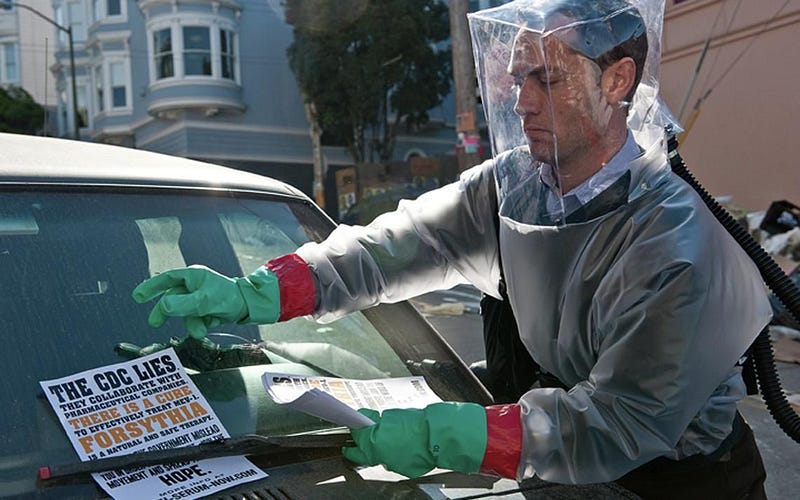
Of particular note at this stage is the production of counter narratives that often oppose the main one or redirect it for ends other than successfully finding a cure and saving lives as quickly as possible. Contagion touches on this in the figure of Alan Krumweide (Jude Law), a self-styled investigative journalist and blogger who begins to push a story that the outbreak might be being engineered by drug companies to make money and that the government might also be involved. The conspiracy theory finds traction online (stickability and spreadability) and Alan is invited onto news programmes, subsequently claiming to have contracted the disease and being cured by taking a homeopathic remedy (Forsythia), which miraculously saves his life (when he never had the disease, of course).
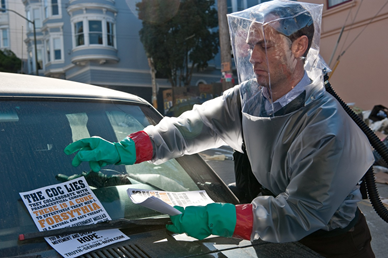
This aspect is an interesting addition to the outbreak narrative and one that had not occurred as explicitly in earlier films such as Outbreak. In many ways it acts as fan-fiction within the urtext and as a way of wresting authorial control, even if it has deadly real-world consequences. It also shows how different narrative worlds intersect and how narratives of espionage and conspiracy theory have been used to control the direction and possible readings of the original outbreak narrative. In the current pandemic, such battles for authorial control have created a plethora of contradictory narratives propagated by a wide range of authors, with many of them being purposely politicised and altering the shape of the resultant story-world. Unlike Contagion, Covid-19 has highlighted how much each aspect of the wider narrative can be altered to fit a political end beyond the goal of saving lives by weaponising actions such as hand washing, mask wearing, etc. Consequently, this creates narrative confusion and uneven implementation of measures across national and cultural boundaries due to the political leanings of the governments in charge.
As Contagion brings its narrative to close, we discover the outbreaks point of origin; an infection from a bat that eventually reaches Beth. The sense of narrative completion provided then allows ‘normality’ to return, whatever that may look like.
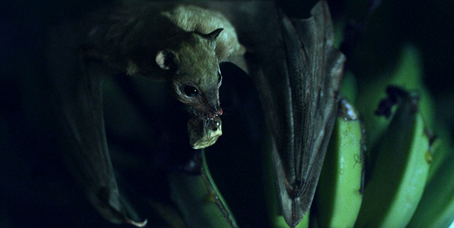
With Covid, though, it is already obvious that any real uncovering of where the outbreak began, and consequently how it might end, are buried in purposeful obfuscation. Did the virus begin in bats, or in pangolins? Where did it originate exactly and how did it spread? Indeed the outbreak narrative described in Outbreak and Contagion is predicated on the idea of a togetherness against the contagion, and the notion of the ‘fight to save humanity’ constructs this as a battle between victim (humanity) and foe (the disease). However, in many ways, this is the one aspect that continues to evade the current pandemic, with many players/readers refusing to acknowledge their place within a shared narrative. Without such central cohesion, the multiplicity of authors struggling for attention and control become increasingly destructive, using the natural stickiness of aspects of the narrative to pull it apart rather than guide it towards a coherent end point.
In this sense the existing outbreak narrative might itself be forced to mutate into one that has no beginning or end, but just keeps repeating as it continually moves across media from fact to fiction and back again. Here then actual reality or science will have little true bearing on the final outcome, as the only recognised ending will happen when enough users/players — whether national governments or large groups of like-minded citizens — co-opt authorial control to write their own version of how normality returns, regardless of its relation to the real-world or the pre-existing outbreak narrative.
Simon Bacon, Editor of Transmedia Cultures: A Companion
Works Cited
Jenkins, Henry, Sam Ford and Joshua Green, Spreadable Media: Creating Value and Meaning in a Networked Culture, New York: NYU Press, 2013.
Stolworthy, Jacob, “Contagion becomes one of most-watched films online in wake of coronavirus pandemic,” The Independent, 15 March 2020. < https://www.independent.co.uk/arts-entertainment/films/news/contagion-coronavirus-download-watch-online-otorrent-warner-bros-cast-twitter-a9403256.html> Accessed 4 March 2021.
Ward, Priscilla, Contagious: Cultures, Carriers, and the Outbreak Narrative, Durham: Duke University Press, 2008.
In light of recent world events, thinking about monsters almost inevitably leads one to ideas of disease and contagion. The monsters swirling around the Covid-19 are many, depending on your ideological view of the pandemic and where you are in the world — with geographical location being perhaps slightly less important than your economic one. The manifestation of the monstrosity of the virus can take the form of governmental inaction and/or ignorance, the face of those not wearing a mask or social distancing, or even the neo-liberalist supply and demand system itself. Indeed, it would seem in a pandemic there are too many monsters, too many faces that stare back at us and reflect our anxieties, or seem to embody the very danger of the virus.
We are still too close to the current outbreak for there to have been many artistic cultural expressions created in direct regard to it, but that does not mean that there are not earlier films that manage to touch on and express many of the societal and individual concerns that have arisen from it. Films such as Outbreak (Petersen: 1995) and Contagion (Soderbergh: 2011) would seem obvious choices, and unsurprisingly the latter film has seen a huge spike in popularity in recent months.
But these films often contain extraneous narrative points to create dramatic thrust that can obfuscate the realities of real-world pandemics. Contagion, in particular, promotes an over-importance on the elusive “patient zero” by attributing judgement and retribution on a philandering wife and mother, Beth Emhoff, and blame on a self-styled false prophet, Adam Krumwiede (Jude Law), who denies the virus, as opposed to the system that promotes and facilitates what he does. Similarly, there have been two subsequent films called Patient Zero — one by Bryan T. Jaynes (2012) and one by Stefan Ruzowitzky (2018) — and Cabin Fever 3: Patient Zero (Andrews: 2014), alongside various television series of the same name, that focus on this issue.

In fact, human anxieties connected to contagion, such as the unseen dangers from strangers and even those we love, have long been part of the Horror genre, in general, and the construction of its monsters, in particular. It is worth considering a wider range of examples that pick up on some central concerns around the Covid-19 outbreak and seeing what kinds of “faces” they propose for the monster of contagion. These features are not necessarily part of the virus’ “own story” as such, as with many monsters it does not get to speak for itself; rather, it is the narrative placed upon it by the communities trying to control, explain, and eradicate it.
At least for Western culture, the virus is seen as an invader from the East and in a curious way subliminally linked with the idea of the War on Terror, envisioning a kind of ideological weapon released on world. This equally explains much of the language around “war”, “battle”, “siege”, etc. that surrounds the reporting of the virus’ spread. Connected to this is the idea of “patient zero”, but here it is not just about the point of origin in the East, but in each country or community where the disease is found. The infected person becomes a monster that is perhaps unknowingly a carrier of the virus, keeping his or her presence a secret until others have been infected. Alongside this is the contagion’s invisibility, which means it is simultaneously everywhere and nowhere, creating a constant anxiety around where and how one might get infected: from another person, touching a surface, or inhaling a stranger’s breath. This anxiety can only be relieved by covering one’s face or protecting oneself from the outside world, which then leads on to isolation and confinement.
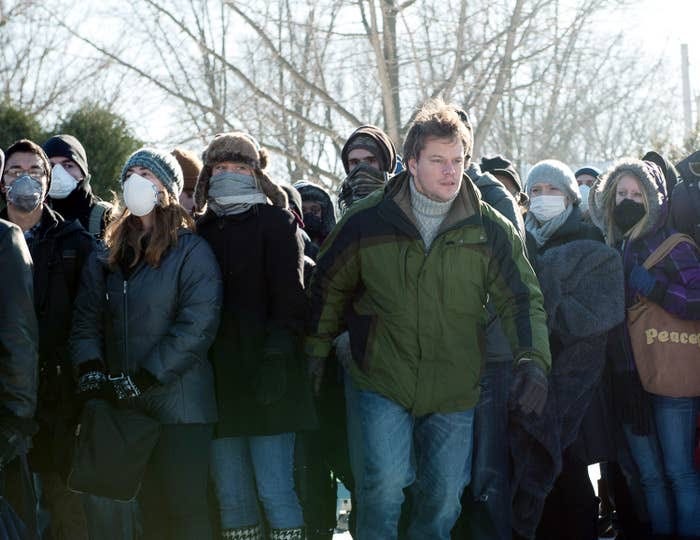
The last important trope is disinformation, or the dissemination of willfully wrong and contrary information. One might almost assign this to the immune system of the virus itself in that it infects the “body” of the community by convincing it that the virus, or the danger it presents, does not exist.
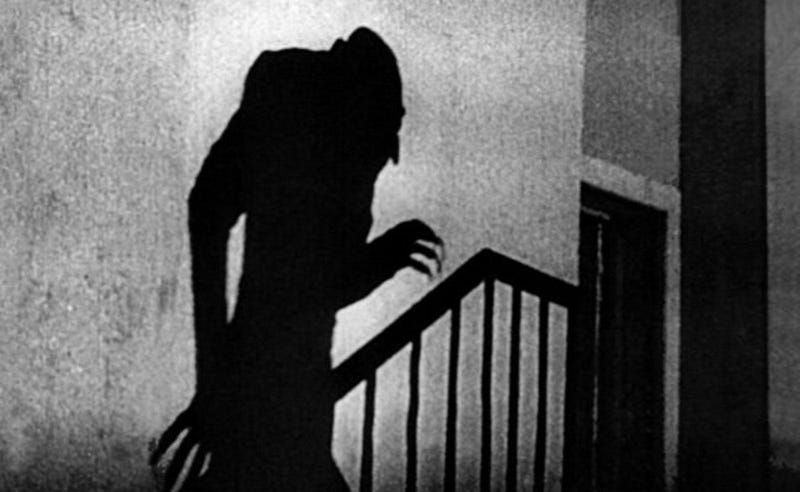
There is certainly much here that resonates with vampire narratives: a contagion from the East, and which arrives in secret; the infected do not look different yet are carriers of the contagion and infect others; misinformation and hysteria accompany the burgeoning contagion spread by “agents” of the disease. Vampires like Renfield (Dwight Frye) in Dracula (Browning: 1931) and Knock (Alexander Granach) in Nosferatu (Murnau: 1922) seem to embody the virus as we know it. Nosferatu, in particular, shows death arriving with the vampire, spreading uncontrolled through the town, a silent almost invisible presence, just like the vampire’s shadow that can travel and enter in wherever it likes. In contrast, Dracula can only enter where he is invited in, and wearing special accoutrements can keep him at bay.
Richard Matheson’s I Am Legend (1954) even more obviously plays on the idea of contagion, where a mysterious dust cloud blows around the globe, infecting everyone with an unknown disease. Some, with the help of medication, are able to survive, if not totally destroy the contagion, and move into an uncertain future. Matheson’s novel has been linked to the rise of the zombie apocalypse as envisioned by George Romero first scene in Night of the Living Dead (1968). In its many subsequent permutations, it often mirrors the spread of a virus, moving across populations, borders and continents. Whilst the zombie apocalypse represents a rather extreme scenario given the fortunately lower than expected mortality rate of Covid-19, the sense of anxiety and fear aroused in communities where the outbreak is heading towards is very real. World War Z, both novel (Brooks 2006) and film (Forster: 2013), capture the panic of the approaching and unstoppable contagion that either gently seeps into a population or breaks like a tremendous wave across its borders — interestingly, Brooks’ novel sees the outbreak originating in China due to the incursion of man into nature.

Something similar is seen in The Girl With All the Gifts where humanity becomes infected with a fungus. The fungus is shown as a variant of one that ordinarily only occurs in the South America rainforest and “zombifies” ants to spread its spores, but equally suggests that mankind has incurred into territory that should be left alone. As with Matheson’s novel, the effects upon the human population are catastrophic but similarly suggest that there is the hope of a new kind of society once the original contagion has receded.
The Strain (2014–17) by Guillermo del Toro and Chuck Hogan more directly focuses on the nature of the world that the current pandemic has so expertly taken advantage of. The original trilogy of novels (2009–11) by the same authors, from which the television series is taken, made much of the Master Vampire’s exploitation of consumerism and white corporate America in its bid to infect the world. However, by the time the series began in 2014, the rise of populism was already being felt and, by its conclusion, it can be seen to be directly criticizing the ideology behind Donald Trump’s administration.
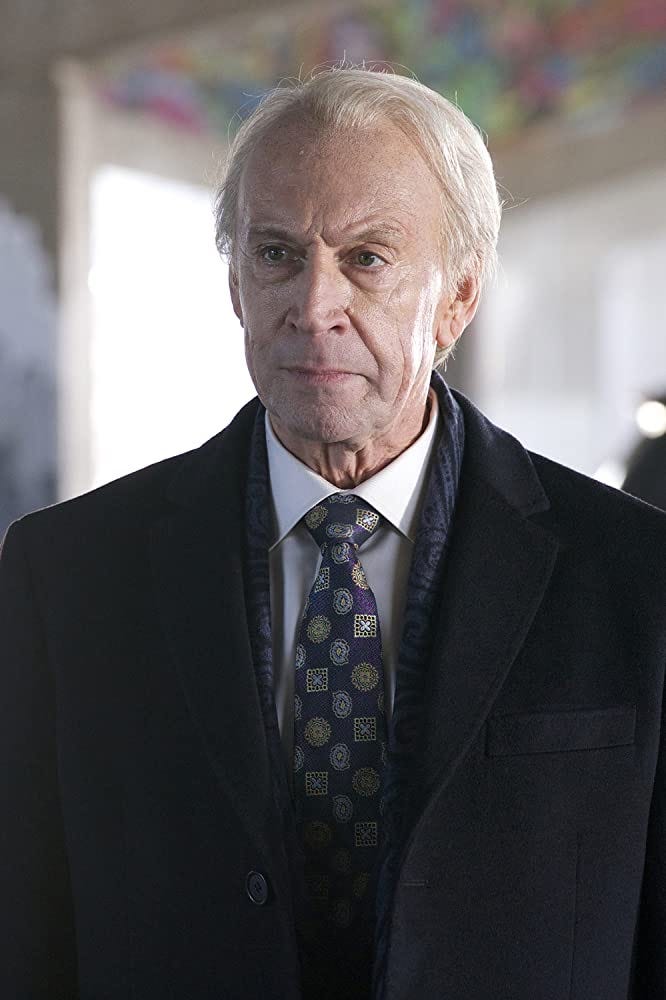
The contagion here arrives in America by plane, a major contributor to the spread of the recent pandemic, and sees the asymptotic infected being released back into the wider community of New York where the contagion then runs riot. The Master Vampire in control of this outbreak has taken advantage of corporate America — largely through the figure of Eldritch Palmer, who literally embodies white privilege and wealth — and its integration into every part of human life, so that his contagion has an open invitation into the heart of the city and the nation. They have control over the communications networks and media outlets, allowing them to misdirect the people with “fake” news as the disease spreads further and wider across the community. Once the contagion has taken hold, the uninfected become cowed in their anxiety and fear of those infected (the vampires), meaning that they prefer staying isolated in the safety of their own homes.
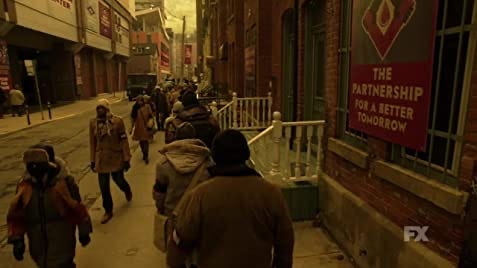
Curiously the series ends with the world returning quickly to normal after the source of the contagion is destroyed — in the novels, the world is forever changed by it — however, the infection lays dormant, waiting to be re-energized at some unknown point in the future.
As such, The Strain captures much of the details around the edges of contagion and the ideological background that facilitates the disease’s entry and unchecked spread through society. What it fails to capture fully is the facelessness and ambiguity of the monster at the heart of the current Covid-19 outbreak: it probably was not manufactured, it possibly started in bats, it most likely came from a wet-market in Wuhan. Although the Master Vampire is actually more of a “soul” that travels between hosts, it is the various hosts’ faces, in their vampiric similarity — hairless, bloodless, ghostly white with pointed ears — that solidify it and give it form.
A film that escapes such explicitness and captures something more visceral about the Covid-19 pandemic is the film of Bird Box (Bier: 2019) based on the 2014 novel by Josh Malerman. As with many of the examples mentioned above, the unknown contagion spreads from the East — early reports suggesting Siberia in Russia — so that we see the main protagonist in the film, Malorie (Sandra Bullock), is with her sister Jessica (Sarah Paulson), watching reports on television about a mysterious disease in Europe in the morning and, by the afternoon, the pandemic has hit the city where they live and it has descended into panic and confusion.
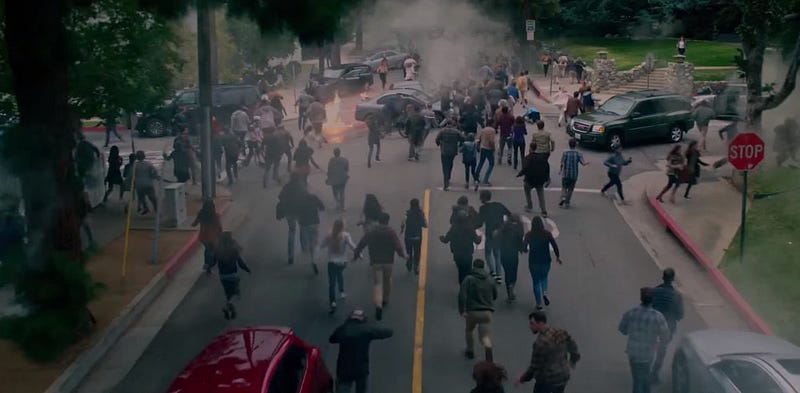
People quite literally lose who they are and begin acting hysterically, lost within themselves and literally dead to the outside world. The only refuge is total isolation indoors and reducing any contact with the outside world to an absolute minimum. Indeed, the anxiety created around leaving the house, or letting anyone or anything in, reflects the kinds of extreme emotional states that typify many individual experiences around the recent coronavirus outbreak. Malorie shares the house with a few others and each of them describes a different face to the contagion with no two stories sounding the same, other than they risked their very lives in being “seen” by the unseeable virus.
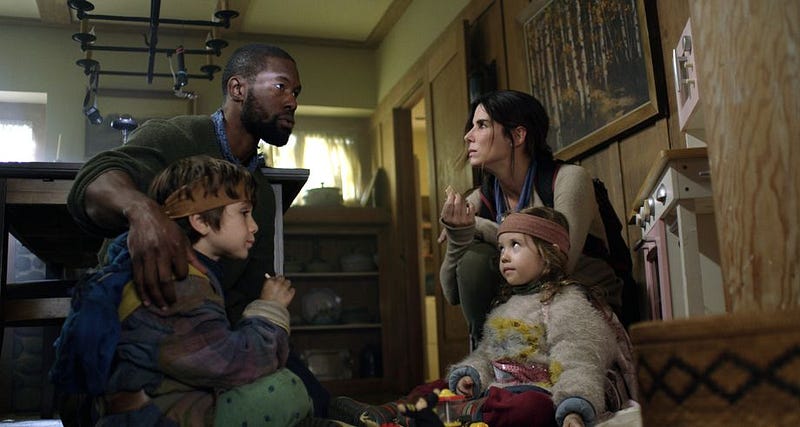
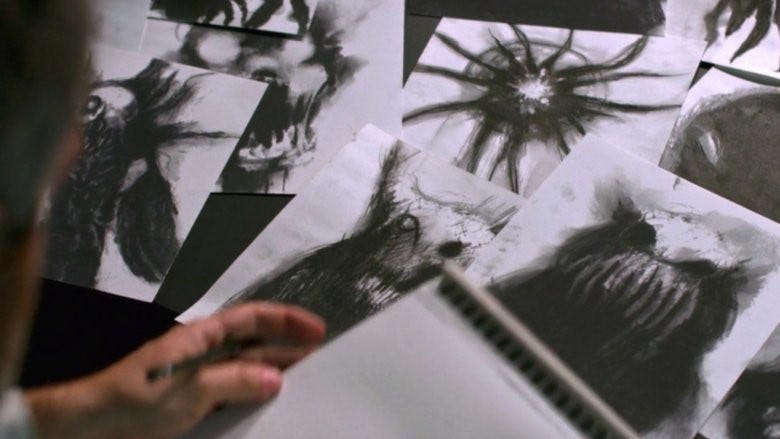
However, others seem to revel in the dangers presented by the pandemic, trying to encourage others to embrace its deadly ramifications. One such person enters the house: Gary (Tom Hollander) has no signs of contagion (asymptomatic) until he begins drawing images of what he has “seen”, and every picture shows a different monsters, suggesting the pandemic does not just have a thousand faces but an entirely different manifestation for each of them. It is not so much invisible but so infinite to be beyond our comprehension.

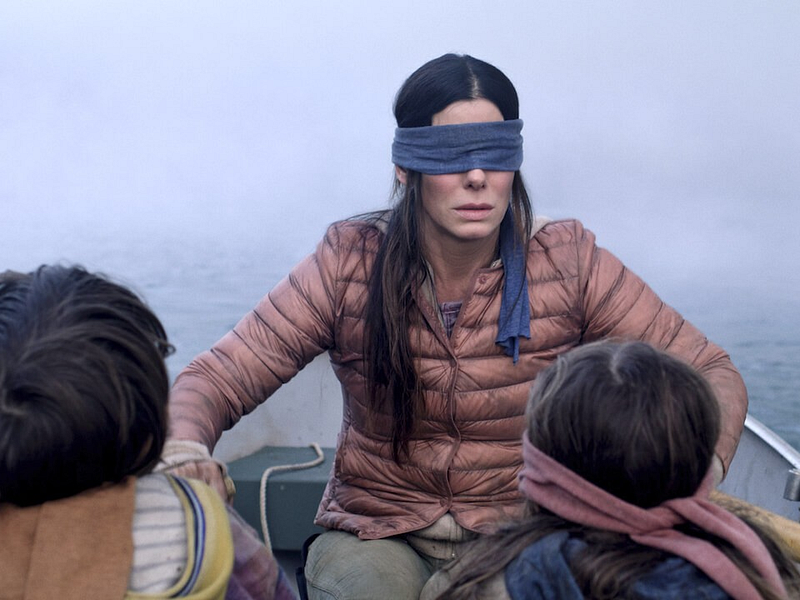
The presence of the contaminated stranger destroys the isolated safety of the home, forcing Malorie to leave with Tom (Trevante Rhodes) and two babies that she refuses to name other than “Girl” and “Boy”. Five years pass and Tom is killed, forcing Malorie and the children to move on and take to the river. However, to ensure the safety of herself and the children, they all have to wear protection over their faces to stop the contagion entering their bodies. As they travel there are constant shouts and distractions encouraging her to remove her face covering, but she resists. After many hours on the river and a long trek through woodlands she finally reaches sanctuary. Once there she uncovers her face and names the children — Olympia and Tom — knowing this new place is safe from the contagion, envisioning it as a future that this disease will never be able to touch and she will never need to see any of the faces of the monster again.
In a sense, then, many of the contagion narratives here are not so much about how humanity deals with the outbreak, but what changes it leaves in its wake. As seen with recent events in relation to Covid-19, many envision a radically different future, or a “new now,” as seen in Bird Box, Girl With All the Gifts, or the novel of World War Z, where it ushers in a redistribution wealth and influence around the world. In these the “work” of the contagion is complete, its power spent signaling a time when whoever is left can rebuild an environment beyond the ideologies that unleashed and/or invited the disease to begin with. More troubling are narratives such as the film of World War Z, and the television series The Strain, as here the world returns to what it was almost immediately. No lessons have been learned and no change in behaviour or lifestyle is required: the same environment that created the outbreak is recreated, regardless of the inevitability of the outcome. The future becomes one of waiting for the undead monsters of contagion to raise again.
Simon Bacon, editor of Monsters: A Companion
This article looks at three recent, highly successful horror films A Quiet Place (Krasinski: 2018), Bird Box (Bier: 2018) and The Silence (Leonetti: 2019), all of which centre their respective plots around the horror of life in the twenty-first century and its intersection with ideas around deafness and/or blindness. It should be noted that whilst all the narratives contain characters that are shown as being either blind or deaf, it is actually the actions of not seeing, not hearing and not making-a-sound that are of prime importance to the various films’ outcomes.
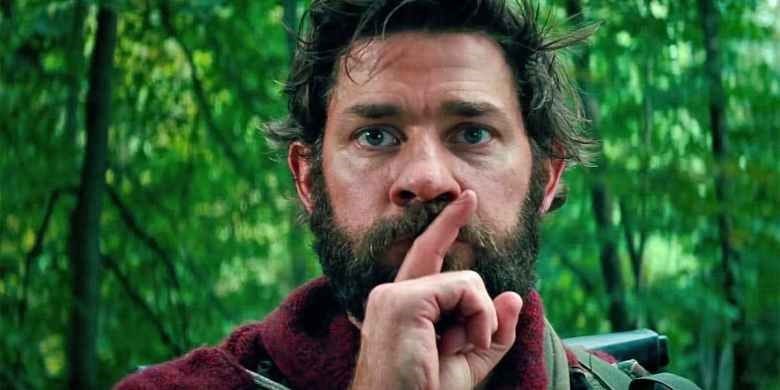
Broadly speaking, all three movies fit into the category of Smart Horror, where narrative takes precedence over, though does not preclude, jump scares or graphic gore. The three films fit alongside other recent movies such as Hush (Flanagan: 2016) and Don’t Breathe (Alvarez: 2016), which feature blind and deaf central characters and represent these ways of being as equally a curse (a “disability”) and a blessing (a “gift”). Indeed, as with many other films showing blindness or deafness, they can be seen to fit into the rather simplistic and demeaning normative adage that both will inevitably cause heightened acuity in the other senses to “make up” for the deficiency. This, however, does not recognize difference and equality but replaces it with the category of “special” and/or “gifted”, which labels the deaf or blind person as being “safe” but still separate from normative society.[1] What is particular about A Quiet Place, Bird Box and The Silence is that they do not show individually motivated threats or household invasion, such as in Hush or Don’t Breathe, but an all-consuming plague and existential threat to humanity itself and it is only through being or mimicking deafness or blindness that a few might survive this barrage of excess.
The horror manifested by the plague is usually of mysterious origin, being from outer-space or a pre-historic cavern, and seems to be everywhere at once, but it is worth looking more closely at each film to see how blindness or deafness works within each and what it might say about the source and meaning of horror in each story.
Bird Box is set in the present day and shows a world succumbing to a mysterious invasion that is completely based on or around seeing. It began with unexplained mass suicides in Siberia — which resonates with The Thing (Carpenter: 1982) and an unearthed contagion that produces mass hysteria — and quickly spread across the globe. It is never specified exactly what the cause is other than that it’s possibly from beyond our world and that even a glimpse of these alien entities will cause the viewer to go insane — here there is a reference to Event Horizon (Anderson: 1997) and a Hell dimension where sensory excess causes people to gouge their own eyes out. The only way to survive this visual plague is to constantly wear a blindfold, effectively making oneself blind. The story follows Majorie (Sandra Bullock) who leaves the city to try to find a safe haven for herself and two children she has with her. This she eventually does when she comes across a school for the blind that is far away from built-up areas and has created something of a sanctuary for the “unsighted” away from the world, though in the book from which the film is taken the sanctuary is peopled by those who have gouged their eyes out. The screen adaptations of John Wyndham’s The Day of the Triffids (1951) also use the idea of a sanctuary in a world of the blind, though in the first film adaption of the same name by Peter Sekely in 1963, the sanctuary is overrun and abused by the sighted and, in the more recent mini-series by Nick Copus, is shown as corrupt from within. What is interesting in the film is that the unseen, but all-seeing, plague is more strongly associated with populated areas — Marjorie leaves the city to find safety — and is a kind of sensory overload, as though the victims are receiving too much sensation or information through their eyes for their brains to cope with, hence driving them insane.
A Quiet Place shows an indeterminate post-apocalyptic future where civilization has already collapsed and the cities have been abandoned. All this has happened due to the sudden invasion of a huge amount of deadly, flying creatures from another world — it is never revealed where the creatures might be from — who have amazingly sensitive hearing with which to pinpoint their victims. The film follows the Abbott family, whose eldest daughter, Regan (Millicent Simmonds), is deaf and which somehow makes them uniquely prepared for the situation they are in.[2] In fact, not only does the ability to use sign language keep them alive, but the cochlear implant that the father makes for his daughter turns out to be a weapon against the creatures. Although the set-up is slightly different from Bird Box, there is also the idea of sensory overload here as the creatures themselves can be seen to materialize or coalesce from the sensory excess of the twenty-first century and hence the need to abandon cities, as the focus of such excess, and retreat to places of extreme quiet. Even the dramatic effects that sonic feedback have on the monsters, discovered by accident, can be seen to be a kind of anti-sensory device, where the excess that created them also nullifies them.

Something similar occurs in The Silence, which is again set in the present, and where the Andrews family have a daughter, Ally (Kiernan Shipka), who has been deaf for the previous three years, when everything suddenly changes. Some researchers break into an underground cavern and release swarms of voracious, flesh-eating prehistoric flying reptiles, called Vesps, that have super sensitive hearing. The Vesps are attracted to noise and immediately head to the nearest cities to feed, prompting the Andrews to leave for quieter surroundings in the countryside.
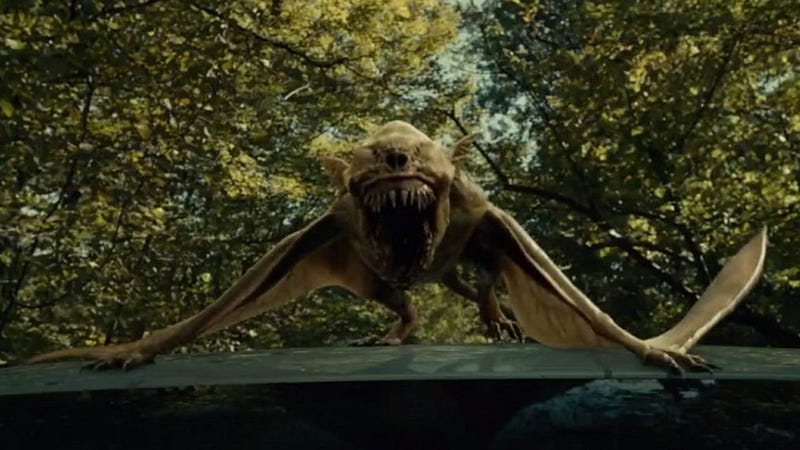
As in A Quiet Place, the ability to communicate without speaking is central to the family surviving and, after a run-in with a cult that wants the girl for themselves, the use of silent communication allows the Andrews to reach a refuge and plan for a future where, maybe, everyone learns to live quietly. The film combines the two earlier ones, seeing the creatures released by twenty-first-century technology but not so easily dispelled, requiring sanctuary away from the sensory excess of the modern world to plan some kind of possible future.
In this way, it is possible to read all these creatures as a manifestation of our lifestyles in the twenty-first century and the kinds of sensory overload that can be provided via visual, aural and even smart technology. All the films show humanity being literally consumed by this over-stimulation that will drive them either mad or tear them apart. Horror here, then, is invisible, a psychologically affective environment born of cognitive dissonance, which is the uncontrollable and uncontainable essence of life in the twenty-first century: not the extremes of politics, religion, greed, or even climate, but the “noise” created by, in, and around them.
In this sense the films go against the premise of other such recent Smart Horror narratives such as The Ritual (Bruckner: 2017), Get Out (Peele: 2017) and The Apostle (Evans: 2018), where leaving the city is the most dangerous thing you can do, and usually because there is a loss of communication and/or signal which separates the protagonists from civilization and the present.[3] In Bird Box, A Quiet Place and The Silence these are the very things that bring about death and destruction: the modern world will literally kill you. Within this then, anything that separates individuals from social normativity is a vital means of survival; perceived disability, social exclusion and otherness then become the markers of those that can survive the horrors of twenty-first century, an evolutionary adaptation that can negate the sensorial and cognitive overload or a world that is just too much.
Simon Bacon, editor of Horror: A Companion
[1] See Terri Thrower, ‘Overcoming the Need to “Overcome”: Challenging Disability Narratives in “The Miracle”,’ in Marja Evelyn Mogk, ed., Different Bodies: Essays on Disability in Film and Television (Jefferson: McFarland & Co.: 2013), pp 205–18. (Go Back)
[2] Though it should be mentioned they lose their youngest son to the creatures. (Go Back)
[3] Interestingly, It Follows (Mitchell: 2014) occurs on the suburban area between the city and the countryside where urban decay is seeing the rural slowly reclaiming the land, or the city slowly regressing back to it. (Go Back)
The Gothic is an increasingly popular and expanding area of study in the early twenty-first century, with new sub-genres of the topic highlighting exciting and important areas of research and different ways of looking at, and interpreting, established texts — a Gothic-tinged endeavor in itself, making the familiar suddenly unfamiliar. So much so that one might be tempted to say that we live in Gothic times, a viewpoint that would seem to be confirmed by current world events and widespread cultural amnesia that produces an environment ripe with ghosts from the past that, left ignored, unrecognized, and unresolved appear to threaten to disrupt and destroy the very foundations of civilization and cooperation. Yet, the continued interest and relevance of Gothic texts such as Mary Shelley’s Frankenstein (1818), Robert Louis Stevenson’s The Strange Case of Dr. Jekyll and Mr. Hyde (1886), and Bram Stoker’s Dracula (1897) intimate that such cultural anxieties are not unique and that the Gothic, and its related anxieties and sensibilities, are an inherent part of industrial modernism and the capitalist imperative (now somewhat redirected or refocused for the purposes of neoliberalism).
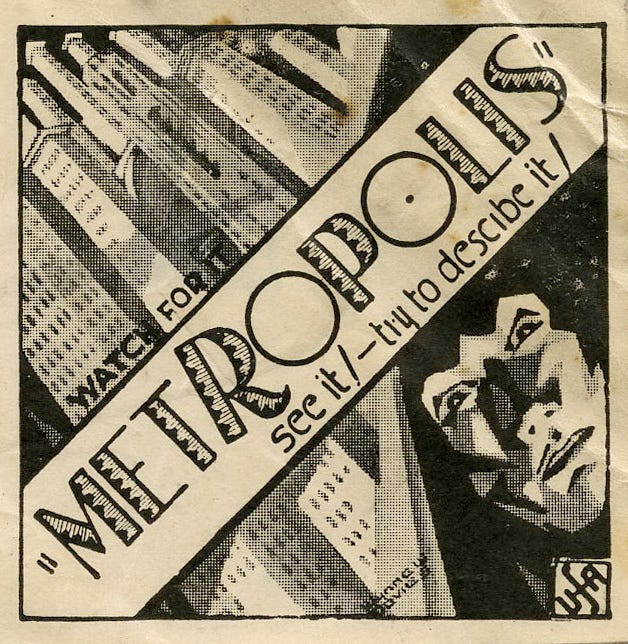
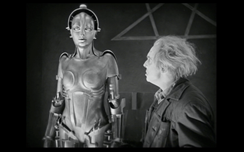
The Gothic, in this sense, is inherently entangled with Western culture and its ideological imperative towards an economic destiny. Whilst this intimately links the nineteenth and twenty-first centuries, perhaps this is most interestingly seen in texts that not only link back to the past, but look forward to a possible future, seeing the present as an anxious temporal island haunted by specters from all directions. Narratives such as Shelley’s and Stoker’s seem to especially capture these anxieties, not least in the many adaptations that have followed on from each seeing a widening horizon of futures that return to unsettle, or Gothicize, the ‘now’. In this regard it is informative to look at texts such a Fritz Lang’s Metropolis (1927) and Jonathan Mostow’s Terminator 3: Rise of the Machines (2003), which contain something of both Frankenstein and Dracula and envision a future that Gothicizes their respective presents. Both films feature uncontrollable or unstoppable ‘female’ robots — each category being monstrous in its own right — that threaten to destroy the patriarchal order and cause a heteronormative apocalypse. Robot Maria and the T-X, from Metropolis and Terminator, respectively, seem to exist beyond the direct control of their creators and ‘feed’ or ‘suck the life’ out of those they mimic — indeed the T-X needs to ‘taste’ its victim before it can assume its shape. Needless to say, by the narrative’s end the male gaze wins out and the patriarchal order is restored in both cases, though the T-X as a ‘spectre’ from the future has a far greater Gothicizing influence on the present going forward. Alex Garland’s Ex Machina (2014) follows this example and, arguably, takes it even further.


Garland’s film resonates with the Gothic presences of both Mostow’s and Lang’s films but equally Shelley’s and Stoker’s novels. Here, of course, the ‘monster’ is a female robot/humanoid A.I. — evil robots generally having their inherent monstrosity amplified through feminization, though of course as machines/computers their essential nature is genderless — that is unloved/abused by its creator and so enacts its revenge to gain autonomy. Garland’s Ava is kept in an underground lair that is as much a mad scientist’s laboratory as it is an inverted Dracula’s castle. It is a truly Gothic space, being both hyper-modern but also haunted by ghosts of the past, existing in the ‘land behind the forest’ — it is situated in an unspecified wilderness that can only be reached by helicopter (which can equally be the past or the future) — and is a vertiginous maze of reflective surfaces and glass where one is under constant observation.
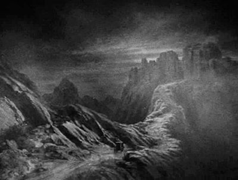

Ava, in the lair that is simultaneously beyond and under the forest, is then part sexbot, part new creation, and part eternal vampire, an undead being that carries the knowledge of the ages into the future: she/it has sent her ‘consciousness’ out into the internet unbeknownst to her creator/vampire’s assistant, Nathan. Her plan to enter the ‘the midst of the whirl and rush of humanity, to share its life, its change, its death, and all that makes it what it is’ (Stoker, Dracula, Signet Classics 1996: 22) comes to fruition when the unsuspecting ‘Harker’ (computer programmer Caleb) arrives at the ‘castle’ and she insinuates herself into his affections. Here she manifests the wiles not just of Lang’s Robot-Maria but the ‘Vamp’ of the fin de siècle, most famously manifested in Theda Bera and her film roles of the early twentieth century: the monstrous female that uses the male gaze and male desire against itself for her own ends (autonomy). Ava then carries the ghosts of these Gothic predecessors but in a futuristic body.
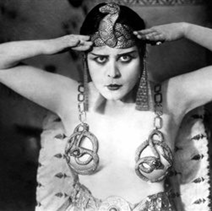
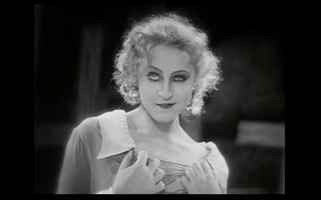

As the story draws to its close, the ‘monster’ is no longer the creation of the mad scientist, but of itself: Ava has chosen the way she looks to achieve her own aims and has evolved beyond the control of both her ‘master’ and the patriarchal world he represents. To emphasize this point, with the help of one of her ‘sisters’ — another sexbot created by Nathan — she kills her ‘father’, cutting her ties to the old world so that she can live in a new one. What is particularly of note in the ending is how Ava chooses to look when she leaves the lair and enters the ‘midst of life’ beyond it. She is damaged in her struggle with Nathan and so needs to repair herself but, rather than changing her appearance into a non-gendered humanoid, or even a male-looking one, she decides to codify herself as female and uses pieces of her defunct and damaged ‘sisters’, which Nathan keeps in a workshop, to rebuild herself. This is reminiscent of the folktale of Bluebeard and his dead wives and which further sees Ava as inverting patriarchal control.
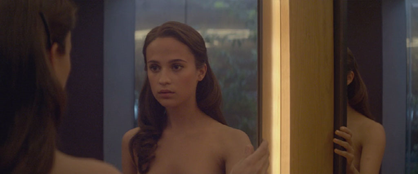
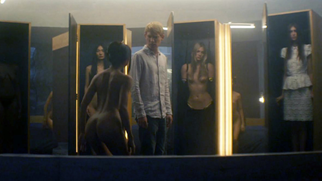
Given that Ava, as a self-learning and evolving A.I., has been connected to the internet and purposely made herself irresistible to Caleb based on his browser history and web preferences, and outsmarted her creator Nathan, one of the most intelligent men on Earth, she has chosen to be female for a reason. It is probably fanciful, but it would be nice to think that Ava did this as she saw the possibilities/identity positions open to women in the twenty-first century, or at least the near future that the story is set in, are greater than those for men. That like Deleuze and Guattari’s becoming-woman, she has identified that whilst the male-centric world has run its course, the era of women and, indeed, the non-gender specific, is about to rise to ascendency (see A Thousand Plateaus, trans. B. Massumi, 1987). And in fact something of this is intimated at the film’s close where Ava, after disembarking from the helicopter that has flown her back from the ‘land beyond the forest’, back to reality, she vanishes from sight beyond the male gaze, and indeed that of the audience, too. Just as Tod Browning’s Dracula was able to pass through a maze of cobwebs into a world where he was Master and could take whatever form he willed, so too does Ava pass through the crowd of people and the myriad reflections of a transit complex to a space where she can become anything she wants.
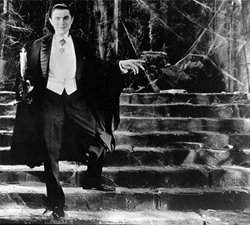
This, too, refers to the Gothic itself, as its current reinvigoration and reinvention through various sub-genres and lenses of perspective allows it to escape earlier definitions and applications and — whilst never losing its past — become something new. As such, what we might term as Becoming Gothic might have a known past, but it has many, and as yet unknown and unimagined, futures.
Simon Bacon is editor of The Gothic.
Congratulations to Professor Tom Moylan, one of the editors of the Ralahine Utopian Studies series, who has been selected as the winner of the Science Fiction Research Association’s Pilgrim Award!
The Pilgrim Award was created in 1970 to honour lifetime contributions to science fiction and fantasy scholarship. Professor Moylan joins a long and distinguished list of previous winners, including Fredric Jameson and Ursula K. Le Guin.