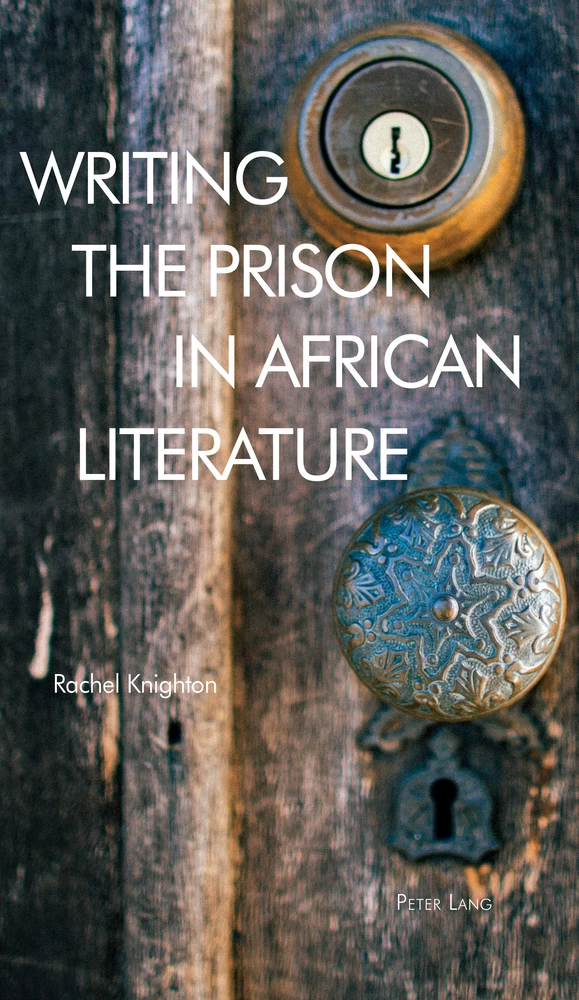
Writing the Prison in African Literature
Summary
Excerpt
Table Of Contents
- Cover
- Title
- Copyright
- About the author
- About the book
- This eBook can be cited
- Contents
- Acknowledgements
- Introduction
- Chapter 1 ‘I was never one for writing diaries’: The Individual and the Collective in Ngugi wa Thiong’o’s Detained: A Writer’s Prison Diary (1981)
- Chapter 2 ‘We were all serving time’: Prison Memoir and Perspectival Variation in Ruth First’s 117 Days (1965)
- Chapter 3 ‘Language needs to be a part of resistance therapy’: Narrating Psychological Breakdown and Political Opposition in Wole Soyinka’s The Man Died (1972)
- Chapter 4 ‘Moving the body means life’: Liberation and the Body in Nawal El Saadawi’s Memoirs from the Women’s Prison (1986)
- Chapter 5 ‘[W]hat song shall I sing from this stench?’: Creating a Prison Poetics in Jack Mapanje’s And Crocodiles Are Hungry at Night (2011)
- Conclusion
- Bibliography
- Index
- Series index
WRITING THE
PRISON IN
AFRICAN
LITERATURE
Rachel Knighton

PETER LANG
Oxford • Bern • Berlin • Bruxelles • New York • Wien
Bibliographic information published by Die Deutsche Nationalbibliothek.
Die Deutsche Nationalbibliothek lists this publication in the Deutsche National- bibliografie; detailed bibliographic data is available on the Internet at http://dnb.d-nb.de.
A catalogue record for this book is available from the British Library.
A CIP catalog record for this book has been applied for at the Library of Congress.
Cover image: Public Domain Archive: http://publicdomainarchive.com/free-stock-photo-old-wooden-door-vintage-knob-rustic/
Cover design by Peter Lang Ltd.
ISBN 2297-2552
ISBN 978-1-78874-647-2 (print) • ISBN 978-1-78874-648-9 (ePDF)
ISBN 978-1-78874-649-6 (ePub) • ISBN 978-1-78874-650-2 (mobi)
© Peter Lang AG 2019
Published by Peter Lang Ltd, International Academic Publishers,
52 St Giles, Oxford, OX1 3LU, United Kingdom
oxford@peterlang.com, www.peterlang.com
Rachel Knighton has asserted her right under the Copyright, Designs and Patents Act, 1988, to be identified as Author of this Work.
All rights reserved.
All parts of this publication are protected by copyright. Any utilisation outside the strict limits of the copyright law, without the permission of the publisher, is forbidden and liable to prosecution. This applies in particular to reproductions, translations, microfilming, and storage and processing in electronic retrieval systems.
This publication has been peer reviewed.
About the book
This book examines a selection of prison memoirs by five renowned African writers: Ngugi wa Thiong’o, Ruth First, Wole Soyinka, Nawal El Saadawi and Jack Mapanje. Detained across the continent from the 1960s onwards due to their writing and political engagement, each writer’s memoir forms a crucial yet often overlooked part of their wider literary work. The author analyses the varied and unique narrative strategies used to portray the prison, formulating a theory of prison memoir as genre that reads the texts alongside postcolonial, trauma, life-writing and prison theory. The book also illustrates the importance of these memoirs in the telling of their historical moment, from apartheid South Africa to post-independence Kenya, Nigeria, Egypt and Malawi.
This eBook can be cited
This edition of the eBook can be cited. To enable this we have marked the start and end of a page. In cases where a word straddles a page break, the marker is placed inside the word at exactly the same position as in the physical book. This means that occasionally a word might be bifurcated by this marker.
Contents
‘I was never one for writing diaries’: The Individual and the Collective in Ngugi wa Thiong’o’s Detained: A Writer’s Prison Diary (1981)
‘We were all serving time’: Prison Memoir and Perspectival Variation in Ruth First’s 117 Days (1965)
‘Language needs to be a part of resistance therapy’: Narrating Psychological Breakdown and Political Opposition in Wole Soyinka’s The Man Died (1972)
‘Moving the body means life’: Liberation and the Body in Nawal El Saadawi’s Memoirs from the Women’s Prison (1986)
‘[W]hat song shall I sing from this stench?’: Creating a Prison Poetics in Jack Mapanje’s And Crocodiles Are Hungry at Night (2011)←vii | viii→
Index←viii | ix→
I would like to thank my PhD Supervisor, Dr Christopher Warnes, for his unrelenting support throughout my work on this project while at Cambridge. Chris was so kind as to complete numerous references on my behalf, as well as providing invaluable feedback on my writing. His belief in the importance of my research enabled it to become what it is today, and for this I am very grateful. The tutors at Girton College were just as instrumental in my academic growth, and I will never forget the moment I read of my successful funding application to become a Girton Graduate Scholar.
While at Cambridge, many more figures stand out, and I am honoured to count these names among those who have advised me during the PhD process. Malachi McIntosh, Priyamvada Gopal and Edward Wilson-Lee in the Faculty of English have been excellent readers of various chapters at different stages of writing. John Lonsdale, Tim Cribb, George Karekwaivanane, Emma Hunter and Ruth Watson from the Centre of African Studies have been of equal help and inspiration.
Details
- Pages
- X, 202
- ISBN (Hardcover)
- 9781788746472
- ISBN (PDF)
- 9781788746489
- ISBN (ePUB)
- 9781788746496
- ISBN (MOBI)
- 9781788746502
- DOI
- 10.3726/b14630
- Language
- English
- Publication date
- 2019 (February)
- Keywords
- Writing the Prison in African Literature prison memoir African writers Africa prison memoir
- Published
- Oxford, Bern, Berlin, Bruxelles, New York, Wien, 2019. X, 202 pp.
- Product Safety
- Peter Lang Group AG
