


 de
de  fr
fr Peter Lang has signed an agreement with East China Normal University Press (ECNUP) to publish an English edition of ECNUP’s new series on the modernization of China’s educational system. ECNUP, founded in 1957, ranks among China’s top 10 university presses. Its education-focused publishing program has been translated into several languages and is also known for introducing Western educational and psychological theories that have influenced the Chinese curriculum. The “China’s Path to Education Modernization” series is planned to cover ten monographs that provide deep analyses, details and insights by top Chinese scholars in the field of educational research. The first volume in English will be published by Peter Lang in 2020 with nine more volumes to follow over the course of the next years.
Publishing group Peter Lang and the Istanbul private university Bahçeşehir Üniversitesi (BAU) have signed a cooperation agreement. It will initially be valid for two years starting in summer 2018. During this period, BAU supports publication projects from its approximately 1000 teachers and research assistants, which are submitted to Peter Lang and accepted for publication. Research in the humanities and social sciences, but also in engineering, is eligible for funding if the research subject touches on humanities topics. The objective of the cooperation is to make scientific research at BAU accessible to a broader international audience. The Peter Lang Publishing Group has had its own office in Turkey since 2015. Its editorial focus is on economics, political science, sociology as well as media and communication sciences. Publication languages are English, German and French (further information).
Media Ecology. An Approach to Understanding the Human Condition by Dr. Lance Strate has won the 2018 Marshall McLuhan Award for Outstanding Book in the Field of Media Ecology. The award was announced at the 19th Annual Convention of the Media Ecology Association, held June 21-24, 2018 at the University of Maine, USA. Named for the Canadian media studies and communications theorist, the Marshall McLuhan Award has been given annually since 2000 by the Media Ecology Association (MEA). Past recipients include Douglas Rushkoff and Neil Postman.
In Media Ecology, Dr. Strate provides a long-awaited introduction to media ecology that serves both readers who are new to the subject and those who enjoy a great deal of familiarity with it. It presents a clear explanation of an intellectual tradition concerned with much more than understanding media, but rather with understanding the conditions that shape us as human beings, drive human history, and determine the prospects for our survial as a species, The book was published by Peter Lang in 2017 in its Understanding Media Ecology series.
The Gothic is an increasingly popular and expanding area of study in the early twenty-first century, with new sub-genres of the topic highlighting exciting and important areas of research and different ways of looking at, and interpreting, established texts — a Gothic-tinged endeavor in itself, making the familiar suddenly unfamiliar. So much so that one might be tempted to say that we live in Gothic times, a viewpoint that would seem to be confirmed by current world events and widespread cultural amnesia that produces an environment ripe with ghosts from the past that, left ignored, unrecognized, and unresolved appear to threaten to disrupt and destroy the very foundations of civilization and cooperation. Yet, the continued interest and relevance of Gothic texts such as Mary Shelley’s Frankenstein (1818), Robert Louis Stevenson’s The Strange Case of Dr. Jekyll and Mr. Hyde (1886), and Bram Stoker’s Dracula (1897) intimate that such cultural anxieties are not unique and that the Gothic, and its related anxieties and sensibilities, are an inherent part of industrial modernism and the capitalist imperative (now somewhat redirected or refocused for the purposes of neoliberalism).
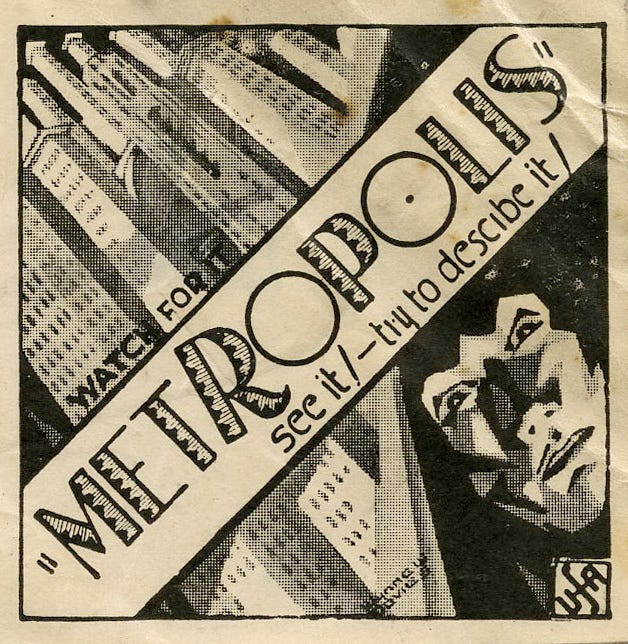
The Gothic, in this sense, is inherently entangled with Western culture and its ideological imperative towards an economic destiny. Whilst this intimately links the nineteenth and twenty-first centuries, perhaps this is most interestingly seen in texts that not only link back to the past, but look forward to a possible future, seeing the present as an anxious temporal island haunted by specters from all directions. Narratives such as Shelley’s and Stoker’s seem to especially capture these anxieties, not least in the many adaptations that have followed on from each seeing a widening horizon of futures that return to unsettle, or Gothicize, the ‘now’. In this regard it is informative to look at texts such a Fritz Lang’s Metropolis (1927) and Jonathan Mostow’s Terminator 3: Rise of the Machines (2003), which contain something of both Frankenstein and Dracula and envision a future that Gothicizes their respective presents. Both films feature uncontrollable or unstoppable ‘female’ robots — each category being monstrous in its own right — that threaten to destroy the patriarchal order and cause a heteronormative apocalypse. Robot Maria and the T-X, from Metropolis and Terminator, respectively, seem to exist beyond the direct control of their creators and ‘feed’ or ‘suck the life’ out of those they mimic — indeed the T-X needs to ‘taste’ its victim before it can assume its shape. Needless to say, by the narrative’s end the male gaze wins out and the patriarchal order is restored in both cases, though the T-X as a ‘spectre’ from the future has a far greater Gothicizing influence on the present going forward. Alex Garland’s Ex Machina (2014) follows this example and, arguably, takes it even further.


Garland’s film resonates with the Gothic presences of both Mostow’s and Lang’s films but equally Shelley’s and Stoker’s novels. Here, of course, the ‘monster’ is a female robot/humanoid A.I. — evil robots generally having their inherent monstrosity amplified through feminization, though of course as machines/computers their essential nature is genderless — that is unloved/abused by its creator and so enacts its revenge to gain autonomy. Garland’s Ava is kept in an underground lair that is as much a mad scientist’s laboratory as it is an inverted Dracula’s castle. It is a truly Gothic space, being both hyper-modern but also haunted by ghosts of the past, existing in the ‘land behind the forest’ — it is situated in an unspecified wilderness that can only be reached by helicopter (which can equally be the past or the future) — and is a vertiginous maze of reflective surfaces and glass where one is under constant observation.

Ava, in the lair that is simultaneously beyond and under the forest, is then part sexbot, part new creation, and part eternal vampire, an undead being that carries the knowledge of the ages into the future: she/it has sent her ‘consciousness’ out into the internet unbeknownst to her creator/vampire’s assistant, Nathan. Her plan to enter the ‘the midst of the whirl and rush of humanity, to share its life, its change, its death, and all that makes it what it is’ (Stoker, Dracula, Signet Classics 1996: 22) comes to fruition when the unsuspecting ‘Harker’ (computer programmer Caleb) arrives at the ‘castle’ and she insinuates herself into his affections. Here she manifests the wiles not just of Lang’s Robot-Maria but the ‘Vamp’ of the fin de siècle, most famously manifested in Theda Bera and her film roles of the early twentieth century: the monstrous female that uses the male gaze and male desire against itself for her own ends (autonomy). Ava then carries the ghosts of these Gothic predecessors but in a futuristic body.


As the story draws to its close, the ‘monster’ is no longer the creation of the mad scientist, but of itself: Ava has chosen the way she looks to achieve her own aims and has evolved beyond the control of both her ‘master’ and the patriarchal world he represents. To emphasize this point, with the help of one of her ‘sisters’ — another sexbot created by Nathan — she kills her ‘father’, cutting her ties to the old world so that she can live in a new one. What is particularly of note in the ending is how Ava chooses to look when she leaves the lair and enters the ‘midst of life’ beyond it. She is damaged in her struggle with Nathan and so needs to repair herself but, rather than changing her appearance into a non-gendered humanoid, or even a male-looking one, she decides to codify herself as female and uses pieces of her defunct and damaged ‘sisters’, which Nathan keeps in a workshop, to rebuild herself. This is reminiscent of the folktale of Bluebeard and his dead wives and which further sees Ava as inverting patriarchal control.
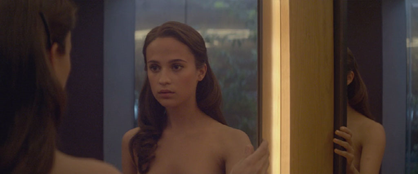
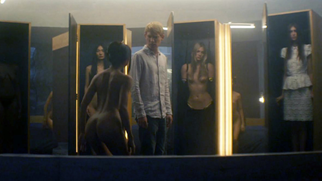
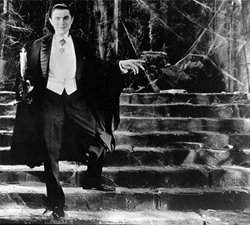
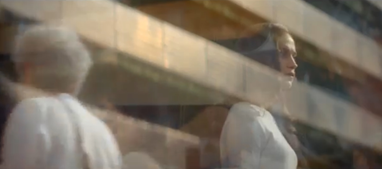
Given that Ava, as a self-learning and evolving A.I., has been connected to the internet and purposely made herself irresistible to Caleb based on his browser history and web preferences, and outsmarted her creator Nathan, one of the most intelligent men on Earth, she has chosen to be female for a reason. It is probably fanciful, but it would be nice to think that Ava did this as she saw the possibilities/identity positions open to women in the twenty-first century, or at least the near future that the story is set in, are greater than those for men. That like Deleuze and Guattari’s becoming-woman, she has identified that whilst the male-centric world has run its course, the era of women and, indeed, the non-gender specific, is about to rise to ascendency (see A Thousand Plateaus, trans. B. Massumi, 1987). And in fact something of this is intimated at the film’s close where Ava, after disembarking from the helicopter that has flown her back from the ‘land beyond the forest’, back to reality, she vanishes from sight beyond the male gaze, and indeed that of the audience, too. Just as Tod Browning’s Dracula was able to pass through a maze of cobwebs into a world where he was Master and could take whatever form he willed, so too does Ava pass through the crowd of people and the myriad reflections of a transit complex to a space where she can become anything she wants.
This, too, refers to the Gothic itself, as its current reinvigoration and reinvention through various sub-genres and lenses of perspective allows it to escape earlier definitions and applications and — whilst never losing its past — become something new. As such, what we might term as Becoming Gothic might have a known past, but it has many, and as yet unknown and unimagined, futures.
Simon Bacon is editor of The Gothic.
Two books, two winners: “Indigenous Cultural Capital. Postcolonial Narratives in Australian Children’s Literature” by Daozhi Xu has received the Biennial Australian Studies in China Book Prize 2018 for an Original Work of Scholarship in English. The monograph is the second volume in Peter Lang’s Australian Studies: Interdisciplinary Perspectives series. The series under the editorship of Prof. Anne Brewster from the University of New South Wales started in 2017 and has already published two award-winning titles: Its first volume “The Mabo Turn in Australian Fiction” by Geoff Rodoreda was granted the Association for Anglophone Postcolonial Studies (GAPS) Dissertation Award 2018.
Australian Studies: Interdisciplinary Perspectives showcases dynamic, innovative research on contemporary and historical Australian culture. More information on the book series can be found here.
Dr. Jean Khalfa, Senior Lecturer in French Studies at Trinity College Cambridge, has taken on the editorship of Peter Lang’s Modern French Identities series. The series publishes monographs, editions or collection of papers based on recent research into modern French literature in English and French. Now in its 127th volume, the series was previously edited by Dr. Peter Collier at the University of Cambridge. Peter Lang is pleased to announce the re-launch of the series under the new editorship and thanks Dr. Collier for his dedicated work over 20 years as editor of the series.
The literary and cultural scholar Aleida Assmann and her husband, the Egyptologist Jan Assmann, will jointly receive Friedenspreis des Deutschen Buchhandels 2018. The prize, worth 25,000 euros, will be awarded on 14 October in the Paulskirche in Frankfurt. Aleida Assmann picks up on the virulent issues of historical oblivion and memory culture; Jan Assmann, through his extensive scientific work, has initiated international debates on the cultural and religious conflicts of our time, according to the jury. In her contribution to the band ‘Other People’s Pain. Narratives of Trauma and the Question of Ethics, Aleida Assman has outlined four models for dealing with a traumatic past. The book was published in 2011 by Peter Lang in the series Cultural History and Literary Imagination.
To celebrate, we are offering Aleida’s work free of charge until July 31, as well as two titles which consider the contributions of Jan and Aleida Assmann.
You can download the titles for free at:
Peter Lang and the Bavarian State Library as negotiators of all consortia in Germany have signed a contract for the use of digital content. Under the agreement, participating libraries have the opportunity to acquire licenses for more than 10,000 e-books as thematic packages, Pick & Choose packages or Evidence-based Acquisition (EBA) without having to conclude their own license agreements. The agreement is effective immediately until and including 30.4.2019. A new addition is the Slavistik Online collection, which Peter Lang acquired in 2017 from Biblion Media.
For more information, visit www.peterlang.com/librarysupport
Effective immediately, Peter Lang takes over the publication of Stanford Slavic Studies. The academic book series was founded in 1987 at the Department of Slavic Languages and Literatures of Stanford University and was published by Berkeley Slavic Specialties until 2016. The co-operation starts with volume 48, that will be published by Peter Lang in the third quarter of 2018.
The series seeks to introduce new perspectives in the study of modern Russian literary history from a national and international perspective. It was founded by Prof. Lazar Fleishman at the Department of Slavic Languages and Literatures of Stanford University, who will continue to lead the editorship.
With the publication of Stanford Slavic Studies, Peter Lang further expands its portfolio in Slavic Studies. In 2017, the group took over the Slavic Studies list from German publisher Biblion Media consisting of around 1,300 backlist titles, 15 active series and two online portals Slavic Studies Online and Futurism Online.
The Association for Anglophone Postcolonial Studies (GAPS) has granted its Dissertation Award 2018 to Dr. Geoff Rodoreda for his doctoral thesis submitted at the University of Stuttgart. The Award is endowed with € 2,000. It is granted once every two years to an outstanding doctoral thesis that advances and expands in an exceptional manner the analytical and/or theoretical approach to the Anglophone literatures around the world, to the study of the varieties of the English, or to other postcolonial cultural forms, practices, and media.
“The Mabo Turn in Australian Fiction” is based on this thesis and was published by Peter Lang in its Australian Studies series. It is the first in-depth, broad-based study of the impact of the Australian High Court’s landmark Mabo decision of 1992 on Australian contemporary fiction.