


 de
de  fr
fr 
by Graeme D. Eddie, author of Sweden’s Pandemic Story: COVID-19, A Chronology 2020–23. Foolhardy, Exceptional, or Just Principled?
In Spring 2020, pandemic year, many media eyes were on Sweden. Narrated to the rest of Europe was the story of no lockdown, no mask-wearing, children still at school, young people lounging about in cafes and parks, and a working economy instead of one closed down. Harshly critical politicians and scientists in other countries warned of such an unorthodox response to such a cruel virus.
As we watched the Swedish Coronavirus drama unfold, we noted the principal characters —the state epidemiologist, the director of the public health agency, the prime minister, and the health and finance ministers. It was not immediately apparent though, that other prominent actors in the drama would turn out to be Swedish and Danish mink (read the book!) and the proud and confident fixed link structure joining Sweden with Denmark.
History of the Bridge
Opened in 2000, and spanning the Sound, or Öresund — the narrow channel joining an arm of the North Sea to the Baltic Sea — separating Sweden and Denmark, the Öresund Bridge had become an iconic symbol of Nordic co-operation and engineering innovation1. Institutionally, structurally, and then physically after the opening of the bridge-tunnel fixed link, Sweden was connected to Europe and fellow member-states of the EU, which it had joined in 1995.
The fixed link represented a compromise between bridge and tunnel preferences, transitioning from a cable-stay bridge to an underwater tunnel, and creating a tangible, unified link for road and rail travel, trade, and culture. Indeed, the bridge had starred alongside Sofia Helin (playing Saga Norén, a Swedish police investigator with Asperger Syndrome) in the acclaimed Nordic crime drama, The Bridge, running 2011–18, and broadcast all over the world.
In June 2000 and every summer between 2002 and 2006, and again in 2010 and 2025, the Danish capital Copenhagen, the Öresund Bridge, and the Swedish city of Malmö had co-hosted Broloppet Half Marathon (The Bridge Run). Although only an occasional sporting event, the 2000 run was still listed among the top ten races in the world based on the number of participants and finishers.
In the first couple of years of its life, total traffic2 across the bridge, including commuter-, leisure-, business traffic, and freight (motorcycles, cars, cars with trailers, busses, trucks and vans) amounted to 1.6 million (2000) and 2.9 million (2001). By 2006, bridge traffic had reached 5.7 million, and revenue was perhaps too lucrative, and the structure too busy, to slow right down for an athletic event lasting much of the day. In 2010, traffic was 7 million, and in 2019 it had reached 7.4 million. And then in 2020, Covid-19 arrived in Sweden.
A Pandemic Story
In autumn 2019, reports came to the Swedish Foreign Ministry of a novel coronavirus outbreak that had gripped the Hubei Province of China. Into 2020, the outbreak would become a global pandemic, as Covid-19 swept the globe and arrived in Sweden, bringing the first confirmed case to the city of Jönköping, in late-January. On 11 March, the day that the WHO declared the outbreak to be a global pandemic, Sweden’s first recorded death from Covid-19 occurred at the Karolinska University Hospital in Huddinge, Stockholm. The victim had been over 70 years old with underlying health problems. By mid-March, and with agreement at EU level, non-essential travel into Sweden was banned from all countries except those in the EEA and Switzerland to mitigate the effects of the outbreak and to reduce the spread of the disease. From 14 March 2020, when stricter rules for entry into Denmark had been imposed, the Öresund Bridge had been partially closed, 20 years since its formal opening to traffic. By the end of–March, the EU was in lockdown, though in Sweden less so.
Widely reported on at the time had been Sweden’s unique approach to tackling Covid-19. It had often been described as an ‘experiment’ and ‘maverick’ and had been met with both harsh criticism and some admiration, both at home and abroad. The approach had been described by scientists, politicians, and journalists alike, as risky, brave, and sometimes foolhardy. Sweden was an ‘outrider’, an ‘outlier’. The criticism and admiration – a fascination in a way – had been particularly focussed on the decision to keep nurseries and primary schools open, a lack of national lockdown, and no mask-wearing. As the months had passed however, and into the second year of the pandemic, it came to be realized that while Sweden had suffered many more deaths than its Nordic neighbours, particularly among the elderly in care homes, there had been substantially fewer Swedish deaths overall than in other EU members states of comparable size — in Czechia, Greece, Hungary, and Portugal for example.
But no matter, in the months of the pandemic, after EU member states had adopted a ‘traffic-light’ system to limit the spread of Covid-19 and to maintain free movement within the bloc under safe conditions, and as neighbouring countries began to put in place more relaxed travel measures, Sweden found itself kept out of these. The concentration of Covid-19 in Sweden prevented it from being included. Those wishing to travel to Denmark from Sweden say, had to have a valid reason for doing so, such as living or working there, delivering vital goods, or holding Danish citizenship.
Coronavirus and the devastation in its wake had abruptly closed European borders with the travel restrictions put in place ending ‘free movement of people’, a central pillar of the EU Treaty. The European route E20 via the Öresund Bridge and through Sweden was one of the main road traffic routes from Copenhagen to Helsinki, Finland, and while the bridge had remained open to freight traffic in either direction, as well as to private vehicular travel to Sweden, there were stricter rules for travel into Denmark from Sweden.
As for the Öresund Bridge, in May 2020, the total traffic — motorcycles, cars, vans, and coaches — had been 292,806. This compared with 650,211 in May 2019. As part of travel and free movement under safe conditions, and on a bridge with much less traffic than in a ‘normal’ year, checks still had to be carried out, and queues soon built up. That May, when a six-kilometre-long line of Danish traffic built up, returning from Sweden after the weekend holiday marking Ascension Day (Kristi himmelsfärdsdag), resentment had been fuelled in Sweden over Danes being able to travel freely into the country, while they were barred from travelling to Denmark without good reason. It would not be until August 2020 before Swedes found themselves being included in what had become known as ‘travel bubbles’.
A Recovery
Well into 2021, following 18 months of disruption and to encourage renewed travel between Sweden and Denmark, the commercial operator of the Öresund Bridge (registered as Øresundsbro Konsortiet) announced the launch of a 3-month discount offer to kickstart use of the bridge again and re-invigorate the Öresund Region concept. This international region, composed of Sweden’s third city of Malmö and the Danish capital Copenhagen, and their regional hinterlands, was supposed to have been a common metropolitan area, but it had undergone division during the pandemic. The hospitality industry had been hit especially hard. The number of overnight stays on either side of the Sound had crashed to a record low during the first half of 2021. In Region Skåne, Sweden’s most southerly, overnight stays in guest or tourist accommodation had decreased by 81 per cent compared with the first half of 2019. In the Capital Region of Denmark and Region Zealand, overnight stays of guests and tourists from Sweden had decreased by 91 per cent.
The launch of a ‘Buy one journey, get one free’ offer available between 1 September and 30 November 2021 was an attempt by the bridge consortium to inject greater optimism and to encourage increased travel on both sides of the Sound. Travellers using the bridge were offered favourable discounts in hotels across the Öresund Region.
Cross-border cooperation to match Danish jobs to Swedish jobseekers, and vice versa, had also gotten underway again by the autumn. One initiative was a collaboration between the Capital Region of Denmark, Malmö and Copenhagen municipalities, the Danish Chamber of Commerce (Dansk Ehrverv), and the Swedish Public Employment Service, aimed at solving a post-pandemic labour crisis on both sides of the Öresund and to fill 53,500 Danish private sector vacancies with 65,000 unemployed people in Skåne. The hotel and restaurant industries on both sides of the cross-border region had been struggling to fill vacancies, with several hotels keeping rooms closed because they had not been able to find staff.
After the 2- to 3-year pandemic blip, the notion of a common metropolitan area of greater Malmö and greater Copenhagen — the Öresund Region concept — would return. While in 2020 and 2021, bridge traffic had dipped to 4.6 million and 4.8 million respectively, back to 2004 levels basically, and affecting revenue and profits, by 2022 traffic had grown to 6.7 million, in 2023 it was 7.2 million, and in 2024 it had reached 7.5 million — back to pre-Covid 19 levels. The region was moving again.
Pandemic closures and reduced traffic had indeed been ‘but a blip’, and the Öresund Region was now recognized as the largest labour market in the Nordic region with a population of 4.2 million, though Malmö was perhaps more of an observer to Copenhagen’s success, being a capital city after all, to Malmö’s third city status in Sweden. Celebrating the 25th anniversary of the opening of the fixed link, another Broloppet Half Marathon was held in June 2025 with 40,000 participants, the first man over the line with quickest time being Daniel Nilsson from Sweden, and the first woman was Sarah Bruun from Denmark — local successes from both countries.
About the parts played by Swedish and Danish mink in this Nordic coronavirus drama, and to discover more, read Sweden’s Pandemic Story: COVID-19, A Chronology 2020–23. Foolhardy, Exceptional, or Just Principled?
1 The construction of the Øresund Bridge was a joint project undertaken by Denmark and Sweden, and the completed bridge is owned and operated by Øresundsbro Konsortiet, jointly owned by the Danish and Swedish states. The formal name of the bridge is Øresundsbron, a Scandinavian ‘hybrid word’ merging the Danish rendering of Øresundsbroen with the Swedish Öresundsbron.
2 Traffic statistics throughout the article are taken from ‘Traffic Statistics’ on the Øresundsbron website: https://www.oresundsbron.com/about-oresundsbron/statistik-och-rapporter/traffic-statistics
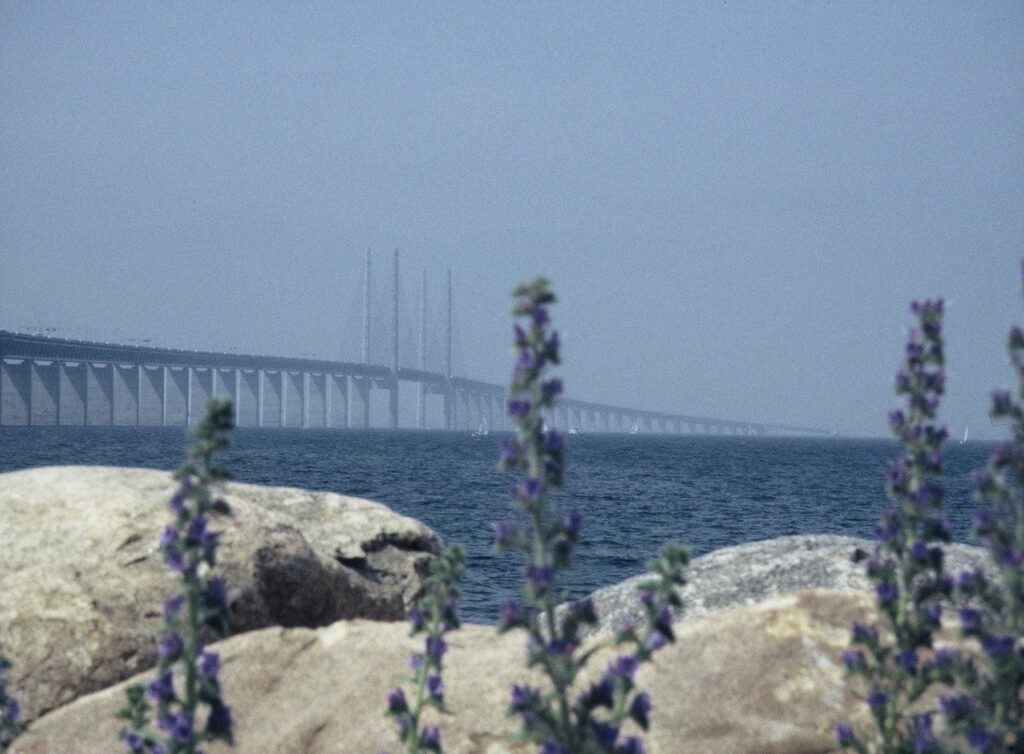
View of the Öresund Bridge from the Swedish abutment. Captured by Graeme D. Eddie.
In the aftermath of war, the bodies of fallen soldiers, whether hastily buried in makeshift graves or left scattered across battlefields, emerge as potent symbols of unresolved questions. My research delves into the complex and often overlooked issue of how to manage these remains, particularly those of soldiers from an invading force, such as German soldiers buried in Russia after World War II. How should these remains be treated? What responsibilities do the living have to the dead? Who has the right to access these graves, repatriate remains, and what role do these actions play in national memory, diplomacy, and ethical considerations?
I focus specifically on the post-World War II context in Russia and the enduring challenge of managing the millions of soldiers’ bodies left behind when relations between former enemies remain fraught. A key part of my research involves examining how the German Wehrmacht handled burials during the war and how Germany, in the war’s aftermath, sought access to the graves of its soldiers. Central to this inquiry are the moral and diplomatic questions surrounding a defeated nation’s right to commemorate its war dead on foreign soil—especially in countries they once invaded.
A significant part of my research explores the role of the Volksbund Deutsche Kriegsgräberfürsorge (VDK), the German War Graves Commission, which has taken on the monumental task of locating and exhuming Wehrmacht graves, identifying remains, constructing new cemeteries, and reburying the dead. Through my work, I shed light on the meticulous and sensitive efforts of the VDK, which involves not only recovery and identification but also navigating complex diplomatic relationships with local and national authorities. These efforts adhere to international humanitarian law, including the Geneva Conventions, ensuring dignified burials for the fallen.

Soviet Union, 1941/ 1942 (Bundesarchiv Bild 121- 1257A
Germany’s Struggle with Remembrance and Responsibility
This ongoing endeavor is not merely about recovering and burying soldiers; it embodies Germany’s profound struggle to come to terms with its own losses while confronting the far more significant responsibility for the immense suffering it caused. Remembrance in Germany is inherently complex and multifaceted. Crucially, this process must prioritize the acknowledgment of the atrocities committed by the Nazi regime, ensuring that the memory of the dead is not used to glorify them but rather to recognize the crimes they were part of, directly or indirectly. It is not about honoring the soldiers as individuals detached from their actions but about confronting the brutal reality of the past and the roles these soldiers played in it. In this way, remembrance becomes not an act of hero worship, but a necessary reckoning with history—a sober reflection on how these individuals contributed to the horrors of war, and how their legacy must serve as a reminder of the dangers of unchecked ideology and the consequences of complicity.
The ongoing dedication of the German government and the VDK emphasizes the importance of these activities in the realms of state diplomacy, wider society, and the military. This commitment is seen in the resources allocated for materials, personnel, and the planning of exhumations. Efforts are made to meticulously collect individual remains and try to name the soldiers, often involving the identification of remains with intact ID tags and reaching out to potential living relatives. This process reflects Germany’s struggle to come to terms with its losses while grappling with its responsibility for the immense suffering it caused during the war.
However, the recovery and burial of soldiers stir deep emotions, both in Germany and in the nations once occupied by German forces. A central challenge lies in balancing the acknowledgment of the atrocities committed by the Nazi regime with the act of commemorating the fallen soldiers. Remembrance in Germany is inherently complex and multifaceted, requiring a careful approach that prioritizes the acknowledgment of historical realities and war crimes without glorifying the military that supported a regime responsible for genocide.
This question is central to my research: how can a nation remember its fallen soldiers without glorifying the military that supported a regime responsible for so much suffering? In my exploration, I trace the evolution of German war graves, from symbols of heroism under the Nazi regime to places of peace and reconciliation under the stewardship of the VDK. This transformation mirrors Germany’s broader journey of reckoning with its past while striving for peace and reconciliation in the present. The ongoing maintenance of these graves, guided by international agreements and conventions, underscores the moral and ethical obligations nations hold toward their fallen soldiers, regardless of their roles in wartime atrocities.
The complexity of these questions resonates with General Alexander Suvorov’s 1799 observation: “A war is not over until the last soldier is buried.” This truth lies at the heart of my research, emphasizing that the dead continue to influence the living. Until every soldier is accounted for, the shadows of war persist. I trace the difficult and often controversial path taken by Germany and Russia in addressing this deeply emotional and politically charged issue. Despite ongoing tensions, my research explores how the Soviet Union and later Russia ultimately allowed Germany access to its soldiers’ graves—a process fraught with controversy and far from straightforward.
These burial sites have evolved into integral components of Europe’s memorial landscape, protected by war grave agreements and recognized for their universal value. The question of whether and how to continue exhumation and commemoration efforts remains a moral and ethical challenge. From a humanitarian perspective, regardless of nationality, the recovery and proper burial of a soldier’s remains are acts of compassion and respect. Nations uphold a lasting responsibility to commemorate their fallen soldiers, even as the decades pass and the likelihood of living relatives becomes increasingly remote.

The Evolving Meaning of Soldiers’ Graves in Post-War Europe
The treatment of soldiers’ graves plays a crucial role in shaping international relations and transnational memory. Bilateral negotiations over grave access and reburial efforts often mark the beginning of post-war reconciliation. These negotiations, extending beyond mere access to Soviet and Russian territories, also involve a re-evaluation of the war and the formation of national narratives tied to soldiers’ graves. The VDK has deliberately positioned its work as a means of fostering peace and reconciliation, as seen in its reconstruction of military cemeteries such as Sologubovka near St. Petersburg. However, Russia has been somewhat hesitant in fully embracing this approach, reflecting the complexity of the post-war relationships between former enemies. While the VDK aims to transform war graves into symbols of collective memory and reconciliation, Russia’s reaction underscores the ongoing sensitivities surrounding the interpretation of these sites. What began as the glorification of fallen soldiers under the Nazi regime has, over time, been reinterpreted as part of the broader process of reconciliation and peace—albeit one shaped by shifting social, state, and temporal dynamics.
The ongoing care of war graves has been enshrined in international treaties and agreements such as the Hague Convention and the Geneva Conventions, emphasizing the protection and preservation of the graves of prisoners of war and soldiers. However, this responsibility goes beyond mere legal obligations. It touches on broader humanitarian principles, the dignity of the dead, and the sensitivity required to navigate these complex narratives. The care given to the dead serves as a reflection of a society’s values and how it confronts the legacy of death and violence resulting from war.
In conclusion, my work underscores the need for critical reflection on how societies remember the war dead, the roles they played in the conflict, and the actions leading to their deaths. This reflection should always be sensitive to the reactions of others, particularly in the context of international memory and reconciliation. Through respectful burial practices and commemoration, nations can move toward a more just and peaceful future, ensuring that the legacies of conflict are acknowledged without being glorified. The ongoing care of these graves serves not only a cultural purpose but stands as a reminder of the past’s lessons for future generations.
Discover the book: Remnants of Wehrmacht Soldiers. Burial and Commemoration Practices of German Soldiers of the Second World War in Russia and Europe, 1941 – 2023.
What is it like when one realizes that they belong to two generations at once? Not chronologically, but in terms of identity and content? Throughout my life I have had a sense of fluid geographical or even national identity, personal identity, professional identity and the like, but only in the past few years did I realize that my generational identity lay at the bottom of much of it.
Generational identity is formed by numerous factors but is not something that is in our hands. We inherit it from our parents and grandparents, and it is passed down to us during our upbringing in direct or subtle ways. It’s a feeling of being part of something bigger than oneself, in which we have a lot of company, and not necessarily the kind we would choose of our own volition. Why? Because belonging to a generation doesn’t always have to do with one’s personal, professional, or gendered identity which often have greater influences on one’s life, personality, and experiences than any other factors. But I’m getting ahead of myself and sound too much like the academic that I am in my professional life. So let me explain what I mean in more personal terms.
I belong to two generations, one on my mother’s side and one on my father’s. Because there was a quarter century difference of age between my parents, something rather significant when they met at 25 and 50, one could say that we are talking about true chronological generations. My mother’s statement to young adults looking for their mate – “At least you can be sure that your spouse was already born” – didn’t necessarily hold true for my father until he was over 25! But that’s not the kind of generation I am referring to, rather more of an experiential and cultural generation.
My mother was an American-born daughter to parents who had been Jewish immigrants from Eastern Europe and came to the United States in the early years of the 20th century. On her side that made me a “next generation”, meaning a second generation American, a grandchild of immigrants. Carrying some of their culture with me, I was already firmly rooted in America in general and my birth city of New York in particular. In view of the 2.2 million Eastern European Jews who immigrated to America between 1881 and 1914 (the years of the “Great Wave of Immigration”), many of whom settled in the general New York City area, I also had a lot of company in that generation.
My father’s experiences, both geographical and personal, were very different than those of my mother. Born in a small town in Poland at the turn of the 20th century, like many Eastern European Jews, he migrated to Germany with his family during the First World War and ended up staying there. Settling in Frankfurt, he married a girl from his hometown and had two children, but the rise of Nazism put an end to their peaceful lives. My father was incarcerated in Buchenwald and later in Auschwitz, his small children became unaccompanied refugee children in Belgium, France, and finally reached the United States in the middle of the war. His wife, who had returned to her parents in Poland during the war, was murdered along with them. After his liberation, my father ended up founding a postwar Kibbutz, brought its members to Palestine, travelled to the United States to find his children, and ended up staying there for over two decades, during which he met my mother, married, and I was born.
On my father’s side, therefore, I was a member of the “Second Generation”, children of Holocaust survivors, making me a member of two generations at once, the “Next Generation” and the “Second Generation, each with their own characteristics and issues. I wasn’t alone. Quite a number of Holocaust survivors married American-born spouses, which made me part of a much larger cohort, including some with whom I went to school. As children we never spoke about our background, but we definitely had a lot in common, things that we didn’t have to express in order to feel and understand.
Had it ended there, I would have been one of many Second Generation American-born children of Holocaust survivors who were also grandchildren of early 20th century Jewish immigrants to America, living in the United States. But here comes the twist. When I was 15 my family decided to move to Israel, enabling me to experience the “immigrant experience” myself, and not just hear about it from my grandparents or father.
What generational group did I really belong to? From the time I was 15 I was not just a member of the “Next Generation” and\or the “Second Generation”. I was a second- generation American who was also a child of Holocaust survivors who immigrated to Israel. Additionally, we were Orthodox Jews, which put me into yet another category. For the pièce de résistance, I then became a Holocaust historian, merging my professional identity with part of my generational one.
Sounds complicated? In some ways it was a lot easier than it sounds as the parts fit together pretty well, especially after my American-born mother decided to make anything having to do with Holocaust commemoration a central part of her being. Sounds lonely? Actually not. Quite a number of Orthodox Jewish families where one parent was American-born and the other a Holocaust survivor, moved to Israel during the years that we immigrated. In my neighborhood alone, I knew at least ten teenagers and young adults who fit into the same generational categories as I did. And believe it or not, I wasn’t the only Holocaust historian who fit into those two generations. Even in Israel. I had company.
“The Next Generation” is the story of what I did with all those identities and generations. How I weaved them into the person I became personally and professionally. How I grappled with the legacies of the two generations, along with the personal legacies of my family, and how I came to terms with deciding what parts of that legacy I wished to emulate, replicate, and pass down to future generations. At the same time, each part of the story is not just my personal story, but rather the story of a generation, colored in part by issues of specific personalities, tendencies, desires, and experiences. Writing the book was a labor of love that took many years, causing me to think and rethink those identities and their significance.
Many of us often speak about personal resolutions that we wish to adopt, and as we get older, quite a number of us put together “bucket lists” of what we want to achieve and experience in the time that is left to us. Writing “The Next Generation” gave me the opportunity of understanding the dynamics of my past and my identities in order to enable to me formulate the resolutions I wished to make and the “bucket list” that I still wanted to experience. It was a difficult process that is still an ongoing one as I write these words, but its ongoing nature is also exhilarating, proving that at every age we still have the capacity to develop, grow, and change.
The book “The Next Generation” can be bought here
Professor David Jacques, author of Blick Mead: Exploring the ‘First Place’ in the Stonehenge Landscape has won the Current Archaeology award for Archaeologist of the Year: https://archaeology.co.uk/vote Jacques was awarded the prize for the work that he has spearheaded at Blick Mead, which is the basis of Peter Lang’s Studies in the British Mesolithic and Neolithic series.
David Jacques has been the Project Director of Blick Mead, an internationally significant Mesolithic archaeological site, c. 2km from Stonehenge since 2005. Along with a number of leading specialists and community volunteers this team has discovered the oldest occupation site in the Stonehenge area and the place where the communities who built the first monuments at Stonehenge lived. These discoveries have contributed significantly to a new understanding of the initial settlement patterns and practices in the Stonehenge landscape.
Congratulations to Judith Tydor Baumel-Schwartz and Dalia Ofer, editors of Her Story, My Story? Writing About Women and the Holocaust selected as a finalist of the 2020 National Jewish Book Awards in the category of Women’s Studies: Barbara Dobkin Award. Since its inception in 1950, the National Jewish Book Awards is the longest-running North American awards program of its kind and is recognized as the most prestigious. The Awards are intended to recognize authors, and encourage reading, of outstanding English-language books of Jewish interest.
We are pleased to announce that Rafaelle Nicholson’s Ladies and Lords A History of Women’s Cricket in Britain has been nominated for the prestigious Cricket Society and MCC Book of the Year Award 2021.
We are proud to announce that Rafaelle Nicholson’s Ladies and Lords A History of Women’s Cricket in Britain has been shortlisted for the Lord Aberdare Literary Prize 2020.
As part of our Sport, History and Culture series, Ladies and Lords offers the first ever academic study of women’s cricket in Britain from its origins in the 18th century to the present day. It examines women’s cricket from grassroots to international level, in schools, universities, the workplace and clubs. The book draws on a wealth of new source material including player diaries and scrapbooks, club records and the records of the Women’s Cricket Association.
“Utilising her skills as both an academic and well respected journalist, the volume reflects at length on why, when so much has been written on cricket from both literary and academic perspectives, the female element has been largely ignored.” — Russell Holden, Nordic Sports Science Forum
Rafaelle Nicholson completed her PhD thesis at Queen Mary University of London. Prior to this she gained a BA in Modern History and Politics at Merton College, Oxford, and an MSt in Women’s Studies at Mansfield College, Oxford. She has written on women’s cricket for ESPNCricinfo and Wisden, and is the editor of the women’s cricket website CRICKETher.com.
The Lord Aberdare Literary Prize is awarded each year by the British Society of Sports History for the best book on any aspect of the history of sport in Britain or for the best book on any aspect of sports history written by a British author. The winner will be announced at the 2020 BSSH Conference, which is being held online from August 26 – 28. In 2014, this prize was awarded to David Snowdon for Writing the Prizefight: Pierce Egan’s Boxiana World.
Jana Buresova has been awarded the Honorary Silver Medal of Jan Masaryk by the Czech Republic for her book The Dynamics of Forced Female Migration from Czechoslovakia to Britain, 1938–1950
Dr. Buresova was honoured at an event at the Czech Embassy on 5 November 2019. The Honorary Silver Medal is awarded by the Ministry of Foreign Affairs of the Czech Republic for outstanding contributions to the development of relations between the Czech Republic and the United Kingdom, and is one of the highest awards that can be received by foreign nationals. Read more about her research and activities at the IMLR’s Research Centre for German & Austrian Exile Studies here
Dr. Buresova’s book was published in the Exile Studies book series edited by Andrea Hammel earlier this year.
Sir David Nairne. The Life of a Scottish Jacobite at the Court of the Exiled Stuarts by Edward Corp (Peter Lang, 2018) has been shortlisted for the Saltire Society Literary Awards in the “History Book of the Year” category. The prestigious awards celebrate and support literary and academic excellence across six distinct categories. Books nominated in the “History Book of the Year” category must be written by authors of Scottish descent or living in Scotland, or dealing with the work or life of a Scot, a Scottish question, event or situation. The winner of each book Award will receive a cash prize of £2,000 and go on to be considered for the top prize of £5,000, awarded to the Saltire Society Book of the Year. For more details about the Saltire Society Literary Awards and the 2018 shortlist, click here.
The literary and cultural scholar Aleida Assmann and her husband, the Egyptologist Jan Assmann, will jointly receive Friedenspreis des Deutschen Buchhandels 2018. The prize, worth 25,000 euros, will be awarded on 14 October in the Paulskirche in Frankfurt. Aleida Assmann picks up on the virulent issues of historical oblivion and memory culture; Jan Assmann, through his extensive scientific work, has initiated international debates on the cultural and religious conflicts of our time, according to the jury. In her contribution to the band ‘Other People’s Pain. Narratives of Trauma and the Question of Ethics, Aleida Assman has outlined four models for dealing with a traumatic past. The book was published in 2011 by Peter Lang in the series Cultural History and Literary Imagination.
To celebrate, we are offering Aleida’s work free of charge until July 31, as well as two titles which consider the contributions of Jan and Aleida Assmann.
You can download the titles for free at: