
 de
de  fr
fr 
by Graeme D. Eddie, author of Sweden’s Pandemic Story: COVID-19, A Chronology 2020–23. Foolhardy, Exceptional, or Just Principled?
In Spring 2020, pandemic year, many media eyes were on Sweden. Narrated to the rest of Europe was the story of no lockdown, no mask-wearing, children still at school, young people lounging about in cafes and parks, and a working economy instead of one closed down. Harshly critical politicians and scientists in other countries warned of such an unorthodox response to such a cruel virus.
As we watched the Swedish Coronavirus drama unfold, we noted the principal characters —the state epidemiologist, the director of the public health agency, the prime minister, and the health and finance ministers. It was not immediately apparent though, that other prominent actors in the drama would turn out to be Swedish and Danish mink (read the book!) and the proud and confident fixed link structure joining Sweden with Denmark.
History of the Bridge
Opened in 2000, and spanning the Sound, or Öresund — the narrow channel joining an arm of the North Sea to the Baltic Sea — separating Sweden and Denmark, the Öresund Bridge had become an iconic symbol of Nordic co-operation and engineering innovation1. Institutionally, structurally, and then physically after the opening of the bridge-tunnel fixed link, Sweden was connected to Europe and fellow member-states of the EU, which it had joined in 1995.
The fixed link represented a compromise between bridge and tunnel preferences, transitioning from a cable-stay bridge to an underwater tunnel, and creating a tangible, unified link for road and rail travel, trade, and culture. Indeed, the bridge had starred alongside Sofia Helin (playing Saga Norén, a Swedish police investigator with Asperger Syndrome) in the acclaimed Nordic crime drama, The Bridge, running 2011–18, and broadcast all over the world.
In June 2000 and every summer between 2002 and 2006, and again in 2010 and 2025, the Danish capital Copenhagen, the Öresund Bridge, and the Swedish city of Malmö had co-hosted Broloppet Half Marathon (The Bridge Run). Although only an occasional sporting event, the 2000 run was still listed among the top ten races in the world based on the number of participants and finishers.
In the first couple of years of its life, total traffic2 across the bridge, including commuter-, leisure-, business traffic, and freight (motorcycles, cars, cars with trailers, busses, trucks and vans) amounted to 1.6 million (2000) and 2.9 million (2001). By 2006, bridge traffic had reached 5.7 million, and revenue was perhaps too lucrative, and the structure too busy, to slow right down for an athletic event lasting much of the day. In 2010, traffic was 7 million, and in 2019 it had reached 7.4 million. And then in 2020, Covid-19 arrived in Sweden.
A Pandemic Story
In autumn 2019, reports came to the Swedish Foreign Ministry of a novel coronavirus outbreak that had gripped the Hubei Province of China. Into 2020, the outbreak would become a global pandemic, as Covid-19 swept the globe and arrived in Sweden, bringing the first confirmed case to the city of Jönköping, in late-January. On 11 March, the day that the WHO declared the outbreak to be a global pandemic, Sweden’s first recorded death from Covid-19 occurred at the Karolinska University Hospital in Huddinge, Stockholm. The victim had been over 70 years old with underlying health problems. By mid-March, and with agreement at EU level, non-essential travel into Sweden was banned from all countries except those in the EEA and Switzerland to mitigate the effects of the outbreak and to reduce the spread of the disease. From 14 March 2020, when stricter rules for entry into Denmark had been imposed, the Öresund Bridge had been partially closed, 20 years since its formal opening to traffic. By the end of–March, the EU was in lockdown, though in Sweden less so.
Widely reported on at the time had been Sweden’s unique approach to tackling Covid-19. It had often been described as an ‘experiment’ and ‘maverick’ and had been met with both harsh criticism and some admiration, both at home and abroad. The approach had been described by scientists, politicians, and journalists alike, as risky, brave, and sometimes foolhardy. Sweden was an ‘outrider’, an ‘outlier’. The criticism and admiration – a fascination in a way – had been particularly focussed on the decision to keep nurseries and primary schools open, a lack of national lockdown, and no mask-wearing. As the months had passed however, and into the second year of the pandemic, it came to be realized that while Sweden had suffered many more deaths than its Nordic neighbours, particularly among the elderly in care homes, there had been substantially fewer Swedish deaths overall than in other EU members states of comparable size — in Czechia, Greece, Hungary, and Portugal for example.
But no matter, in the months of the pandemic, after EU member states had adopted a ‘traffic-light’ system to limit the spread of Covid-19 and to maintain free movement within the bloc under safe conditions, and as neighbouring countries began to put in place more relaxed travel measures, Sweden found itself kept out of these. The concentration of Covid-19 in Sweden prevented it from being included. Those wishing to travel to Denmark from Sweden say, had to have a valid reason for doing so, such as living or working there, delivering vital goods, or holding Danish citizenship.
Coronavirus and the devastation in its wake had abruptly closed European borders with the travel restrictions put in place ending ‘free movement of people’, a central pillar of the EU Treaty. The European route E20 via the Öresund Bridge and through Sweden was one of the main road traffic routes from Copenhagen to Helsinki, Finland, and while the bridge had remained open to freight traffic in either direction, as well as to private vehicular travel to Sweden, there were stricter rules for travel into Denmark from Sweden.
As for the Öresund Bridge, in May 2020, the total traffic — motorcycles, cars, vans, and coaches — had been 292,806. This compared with 650,211 in May 2019. As part of travel and free movement under safe conditions, and on a bridge with much less traffic than in a ‘normal’ year, checks still had to be carried out, and queues soon built up. That May, when a six-kilometre-long line of Danish traffic built up, returning from Sweden after the weekend holiday marking Ascension Day (Kristi himmelsfärdsdag), resentment had been fuelled in Sweden over Danes being able to travel freely into the country, while they were barred from travelling to Denmark without good reason. It would not be until August 2020 before Swedes found themselves being included in what had become known as ‘travel bubbles’.
A Recovery
Well into 2021, following 18 months of disruption and to encourage renewed travel between Sweden and Denmark, the commercial operator of the Öresund Bridge (registered as Øresundsbro Konsortiet) announced the launch of a 3-month discount offer to kickstart use of the bridge again and re-invigorate the Öresund Region concept. This international region, composed of Sweden’s third city of Malmö and the Danish capital Copenhagen, and their regional hinterlands, was supposed to have been a common metropolitan area, but it had undergone division during the pandemic. The hospitality industry had been hit especially hard. The number of overnight stays on either side of the Sound had crashed to a record low during the first half of 2021. In Region Skåne, Sweden’s most southerly, overnight stays in guest or tourist accommodation had decreased by 81 per cent compared with the first half of 2019. In the Capital Region of Denmark and Region Zealand, overnight stays of guests and tourists from Sweden had decreased by 91 per cent.
The launch of a ‘Buy one journey, get one free’ offer available between 1 September and 30 November 2021 was an attempt by the bridge consortium to inject greater optimism and to encourage increased travel on both sides of the Sound. Travellers using the bridge were offered favourable discounts in hotels across the Öresund Region.
Cross-border cooperation to match Danish jobs to Swedish jobseekers, and vice versa, had also gotten underway again by the autumn. One initiative was a collaboration between the Capital Region of Denmark, Malmö and Copenhagen municipalities, the Danish Chamber of Commerce (Dansk Ehrverv), and the Swedish Public Employment Service, aimed at solving a post-pandemic labour crisis on both sides of the Öresund and to fill 53,500 Danish private sector vacancies with 65,000 unemployed people in Skåne. The hotel and restaurant industries on both sides of the cross-border region had been struggling to fill vacancies, with several hotels keeping rooms closed because they had not been able to find staff.
After the 2- to 3-year pandemic blip, the notion of a common metropolitan area of greater Malmö and greater Copenhagen — the Öresund Region concept — would return. While in 2020 and 2021, bridge traffic had dipped to 4.6 million and 4.8 million respectively, back to 2004 levels basically, and affecting revenue and profits, by 2022 traffic had grown to 6.7 million, in 2023 it was 7.2 million, and in 2024 it had reached 7.5 million — back to pre-Covid 19 levels. The region was moving again.
Pandemic closures and reduced traffic had indeed been ‘but a blip’, and the Öresund Region was now recognized as the largest labour market in the Nordic region with a population of 4.2 million, though Malmö was perhaps more of an observer to Copenhagen’s success, being a capital city after all, to Malmö’s third city status in Sweden. Celebrating the 25th anniversary of the opening of the fixed link, another Broloppet Half Marathon was held in June 2025 with 40,000 participants, the first man over the line with quickest time being Daniel Nilsson from Sweden, and the first woman was Sarah Bruun from Denmark — local successes from both countries.
About the parts played by Swedish and Danish mink in this Nordic coronavirus drama, and to discover more, read Sweden’s Pandemic Story: COVID-19, A Chronology 2020–23. Foolhardy, Exceptional, or Just Principled?
1 The construction of the Øresund Bridge was a joint project undertaken by Denmark and Sweden, and the completed bridge is owned and operated by Øresundsbro Konsortiet, jointly owned by the Danish and Swedish states. The formal name of the bridge is Øresundsbron, a Scandinavian ‘hybrid word’ merging the Danish rendering of Øresundsbroen with the Swedish Öresundsbron.
2 Traffic statistics throughout the article are taken from ‘Traffic Statistics’ on the Øresundsbron website: https://www.oresundsbron.com/about-oresundsbron/statistik-och-rapporter/traffic-statistics
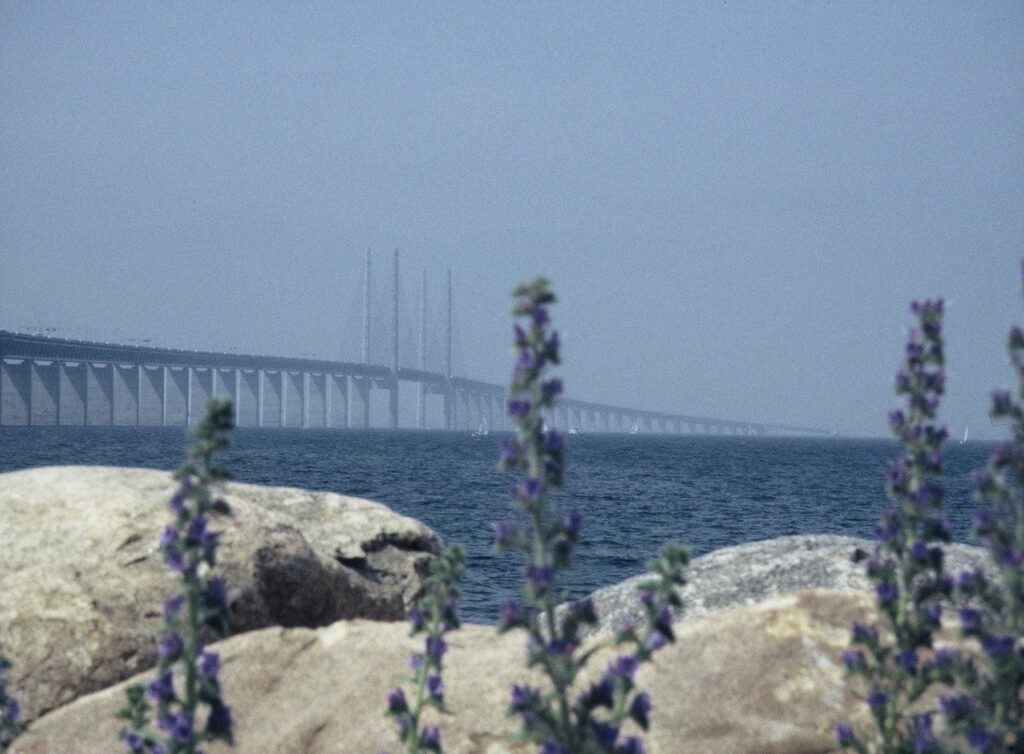
View of the Öresund Bridge from the Swedish abutment. Captured by Graeme D. Eddie.