

International Translation Day is celebrated on the 30th of September each year, with an annual theme selected by the International Federation of Translators (FIT). The chosen theme for 2026 is “Language Diversity and Language Rights: The Power of Being Understood”
This day highlights the essential role of professional language services such as translation, interpretation, and terminology in defending linguistic diversity and equality. It also aims to foster inclusion and participation in a globalised, interconnected world.
The subtitle The Power of Being Understood underscores the pivotal role played by translation in overcoming communication barriers and highlights the importance of translation for modern society’s commitment to social and economic fairness.
As an international academic publisher, Peter Lang has always been dedicated to promoting cross-cultural understanding and disseminating rigorous research across linguistic divides. To mark this year’s celebration, we are proud to spotlight six multilingual titles from our catalogue which explore various contemporary issues in translation.
Translation as access
As a fundamental human right, language rights guarantee the right to access justice, education, healthcare and other public services in a language that can be freely understood, ensuring that everyone has equal access to information. Accessibility therefore represents equity; making this information usable for all, including non-native speakers and people with disabilities, as well as making those from diverse backgrounds feel represented.
Acesibilidad desde un enfoque traductológico explores the bridge between translation and accessibility. It addresses how working with linguistic codes enables the exchange of information between people with diverse communication needs, including translation between modes of communication to provide access to those with hearing and sight impairment, localisation services for those with limited sociolinguistic competence, and language accessibility services such as plain language for those who do not understand specialised language.
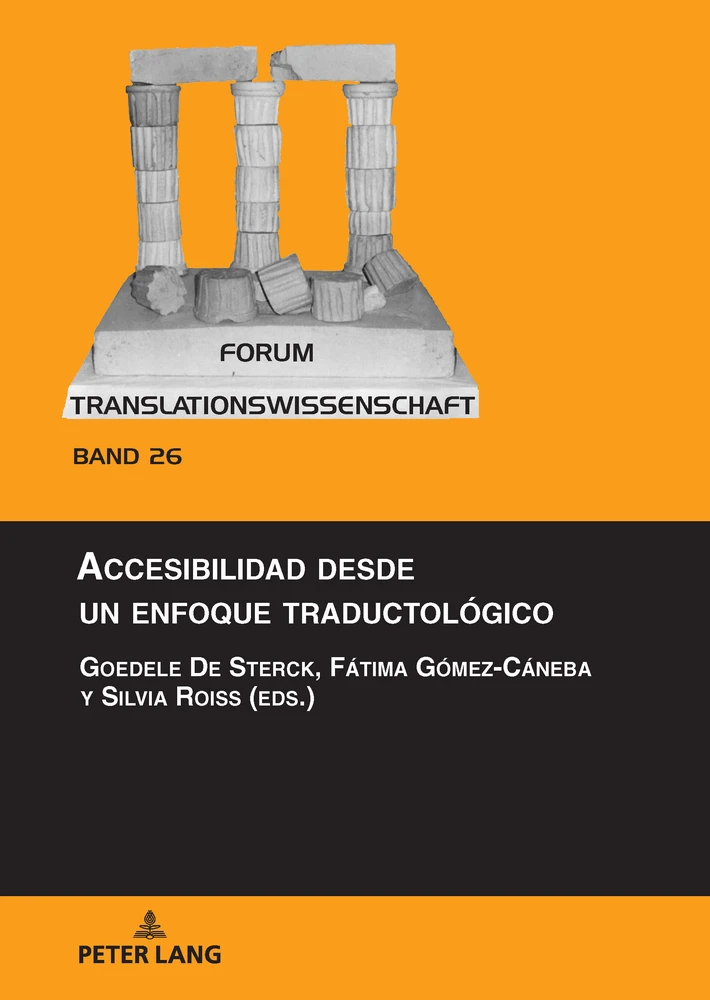
Accesibilidad desde un enfoque traductológico
By Goedele De Sterck, Fátima Gómez-Cáneba, Silvia Roiss
Read more and purchase the book here.
Title Summary:
La obra aborda temas como la audiodescripción, la simplificación y el subtitulado para personas sordas, así como la lengua de signos, el lenguaje claro o la lectura fácil. La tecnología desempeña un papel crucial en los servicios de accesibilidad, por lo que este volumen también cubre los últimos avances tecnológicos, como la IA, aplicados a este ámbito. Con la inclusión de casos concretos y ejemplos, el libro ilustra las aplicaciones prácticas de los conceptos teóricos, proporcionando a los lectores una comprensión más clara de cómo se aplican las teorías en escenarios reales. Este enfoque interdisciplinar une, por lo tanto, estudios de traducción, lingüística, comunicación audiovisual y discapacidad, entre otros. El fin último es que sirva de puente entre estas áreas y que promueva una comprensión más holística de la accesibilidad en y para la traducción y, además, fomente una mayor sensibilización y respeto hacia todos los actores implicados.
Excerpt:
En un mundo cada vez más interconectado, garantizar que todas las personas puedan acceder en igualdad de condiciones a la información se erige en prioridad. Partiendo de este contexto, la alianza entre traducción y accesibilidad ayuda a eliminar barreras y facilita el acceso a contenidos, productos y servicios pertenecientes a todas las áreas de la vida para personas con discapacidades auditivas, visuales o cognitivas.
This book is part of our series Forum Translationswissenschaft. Explore the full series here.
Translation as discourse
Translation is more than swapping words between languages; a translated text is not a simple copy of the original, but a creative re-writing. The view of translation as discourse positions translation as a social and cultural act shaped by ideology. As discourse producers, translators are not neutral machines, rather their choices can reflect, support, or challenge power and socio-cultural preconceptions. In producing a translated text, the translator must interpret the meaning for a new audience.
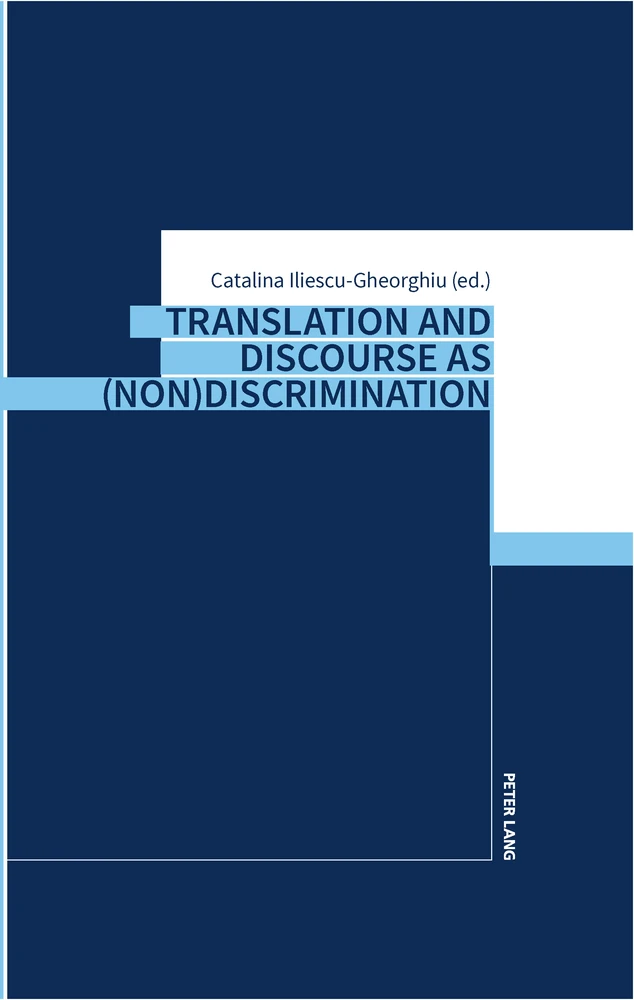
Translation and Discourse as (Non)Discrimination
By Catalina Iliescu-Gheorghiu
Read more and purchase the book here.
Title Summary:
A realistic view of the past should provide a critical understanding of the present, in which discourse producers (including translators and interpreters) must be seen in their socio-political, cultural context. Communication is often hindered by linguistic, cultural, or behavioral differences in the interaction between service providers and service seekers. While there is an extensive literature (sociology, psychology) on different types of discrimination, classified either by its cause (sex, gender, religion), its context (workplace discrimination, border areas), or its consequences (stress, self-stigma, distress), narratives of discrimination seem to be less explored. This volume aims to provide an updated overview of the many facets of intercultural communication and its realities. It emphasizes narratives of otherness and their (conscious or unconscious) presence in policies, social or professional relations, and positive discrimination as a corrective.
Excerpt:
The unprecedented linguistic and cultural diversity which is the result of the migration flows is shown by the book contributors to involve communication challenges due to (linguistic and/or behavioural) barriers in the destination countries between service-providers and service-seekers. There are situations in which communication breakdowns occur both at individual and social level, with some people talking at cross purposes, misrepresenting and distorting the meaning of what others are trying to say, which makes it more necessary than ever to speak with one another, rather than at one another in order to achieve mutual understanding and concerted action. Such types of situations led Bohm to conclude that “shared meaning is really the cement that holds society together, and you could say that the present society has very poor quality cement” (Bohm 2004: ix). Consequently, to reach shared meaning it is essential to understand and reinforce the mechanisms of socially and culturally effective dialogues across (social, gender, cultural, etc.) groups and communities of practice in increasingly multicultural interaction contexts.
Translation in a globalised world
In an increasingly globalised world, translation plays a crucial role in facilitating intercultural exchange and understanding. This globalised context has increased the demand for localisation services; adapting the source text in a manner sensitive to cultural and linguistic differences to ensure the resulting translation is culturally appropriate. In shaping how people share ideas, translation functions as a process of cultural mediation.
Comunicación intercultural, traslación e idiomaticidad
By Laura Ramírez Sainz, Carmen Cayetana Castro Moreno
Read more and purchase the book here.
Title Summary:
El libro explora la intersección entre lengua, cultura y traducción en un mundo globalizado. A través de un enfoque interdisciplinar, los autores examinan cómo las diferencias idiomáticas y culturales impactan en la comprensión cultural y en la traducción. El libro está dividido en capítulos que ofrecen una revisión crítica del papel esencial de la idiomaticidad y la traducción en la comprensión intercultural.
Asimismo se profundiza en las estrategias para superar barreras culturales y lingüísticas, resaltando la importancia de la efectividad en la comunicación intercultural en diversos contextos.
La publicación aquí presente es de especial relevancia para traductores, lingüistas y todo aquel que investigue en el diálogo cultural e invita al lector a ver la traducción y la producción lingüística no solo como un acto lingüístico, sino como un proceso de mediación cultural y entendimiento mutuo.
Excerpt:
La traducción es abordada desde una perspectiva intercultural, evaluando cómo se gestionan las múltiples lenguas dentro de la Unión Europea y examinando casos específicos de traducciones literarias. Los artículos en esta sección destacan la importancia de la naturalidad y la cantabilidad en la traducción de obras musicales, así como la evolución de las traducciones de clásicos literarios a lo largo del tiempo. Además, se explora el papel de los traductores en la transmisión de obras fundamentales de la literatura mundial.
This book is part of our Studien zur Translation und Interkulturellen Kommunikation in der Romania series. Explore the full series here.
Translation and variation
In addition to differences between languages, the translator must also contend with variation embedded within a single language. In L’approche variationnelle dans la terminologie et la traduction juridiques, this idea of variation is explored in the context of legal translation, where a single language can encompass multiple regional legal systems and interlingual translation is not a simple question of a single language pair, but rather requires navigation of differing practices, semantic discrepancies and interpretative challenges.
L’approche variationnelle dans la terminologie et la traduction juridiques
By Jorge Valdenebro Sánchez, Nejmeddine Khalfallah
Read more and purchase the book here.
Title Summary:
Cet ouvrage propose une analyse approfondie des variations terminologiques, conceptuelles et discursives qui traversent les langues du droit et influencent la traduction juridique. À partir de contributions issues de diverses traditions, il montre comment les phénomènes de variation, comme la variation diatopique ou diachronique, entre autres, peuvent entraîner des écarts de sens ou des difficultés d’interprétation qui compliquent la recherche de traductions adaptées au skopos. L’ouvrage souligne que la variation est profondément ancrée au sein d’une même langue : loin de constituer un ensemble homogène, celle-ci se décline en usages professionnels, registres, pratiques institutionnelles et cultures juridiques diverses. Ces différences internes façonnent les concepts, orientent les choix terminologiques et modifient les structures discursives selon les époques, les territoires et les traditions. En offrant un panorama actualisé des travaux en jurilinguistique et en juritraductologie, le volume montre que la compréhension fine de ces variations est indispensable pour analyser, interpréter et traduire les discours et les textes juridiques.
Excerpt:
Si la sociolinguistique a étudié depuis longtemps le phénomène de la variation, la terminologie, la traductologie et, plus spécifiquement, la juritraductologie n’ont commencé que récemment à l’intégrer de manière systématique. Certaines contributions pionnières ont ouvert la voie, comme l’ouvrage coordonné par Caprara, Ortega Arjonilla et Villena Ponsada (2016)7, consacré à la variation linguistique et culturelle, ou la thèse précurseure de Mayoral Asensio (1999)8 sur la traduction de la variation linguistique. Dans le domaine juridique, la thèse d’El Krirh (2015)9 a montré l’importance des phénomènes variationnels dans la terminologie du droit pénal et processuel pénal en espagnol, français et arabe, démontrant que la comparaison de systèmes juridiques occidentaux et arabes révèle des divergences conceptuelles et dénominatives d’une grande portée traductologique.
This book is part of our Studien zur Translation und Interkulturellen Kommunikation in der Romania series. Explore the full series here.
The role of the translator
The value of human translators lies in their ability to provide essential contextual understanding, cultural relevance, and emotional impact when dealing with the text. Machine translation is limited in its capacity to understand and recreate nuanced meaning, making human input indispensable for ensuring the context of the text is accurately maintained. The concept discussed in Translationskonzepte in Brasilien is that translation is not a neutral act; translators function as cultural mediators whose choices are inextricably influenced by their cultural, social and political viewpoints.
Title Summary:
Nach wie vor stellt sich die alte Frage: Was ist die Aufgabe des Übersetzers? Auf der Suche nach Antworten erkundet die brasilianische Translationswissenschaft unterschiedlichste Denktraditionen wie den europäischen Poststrukturalismus einerseits und die modernistische Anthropophagiebewegung Brasiliens, den amerindischen Perspektivismus sowie die afrobrasilianische Mythologie andererseits. Auf diese Weise eröffnet sie Sichtweisen, die im deutschsprachigen Raum fremd erscheinen mögen, es eben dadurch aber erlauben, neue Wege zu beschreiten. Eine wichtige Einsicht ist dabei: Translation ist niemals unschuldig, und Translatoren – ob gewollt oder nicht – sind stets politische Akteure, die maßgeblich bestimmen, wie die übersetzende und die übersetzte Seite zueinander in Beziehung treten.
Diese Arbeit ist mit dem Forschungsförderpreis der Freunde der Universität Mainz e.V. 2024 ausgezeichnet worden.
This book is part of our series FTSK. Publikationen des Fachbereichs Translations-, Sprach- und Kulturwissenschaft der Johannes Gutenberg-Universität Mainz in Germersheim. Explore the full series here.
Technological developments
Rapid advancements in technology are profoundly impacting the translation industry. The rise of AI and machine translation enables the rapid translation of large volumes of text at extremely low costs. However, automated translations must be overseen by human input. The title below discusses how pedagogical approaches to translation and interpreting are changing in response to these technological developments.
Der Einfluss neuer Technologien auf die Ausbildung von Translatoren / The Influence of New Technologies on Translator and Interpreter Education
By Alena Petrova, Bianca Prandi, Astrid Schmidhofer
Read more and purchase the book here.
Title Summary:
In den letzten Jahren haben technologische Entwicklungen, die vor allem auf Fortschritten im Bereich der künstlichen Intelligenz (KI) basieren, zu rasanten, fast revolutionären Veränderungen in der Übersetzungsindustrie und, in etwas geringerem Ausmaß, in der Dolmetschbranche geführt. Die vierzehn Beiträge im vorliegenden Sammelband beleuchten die weitreichenden Auswirkungen von KI auf die translationswissenschaftliche Ausbildung – von der Übersetzungsdidaktik über das Post-Editing bis hin zur Dolmetsch- und Sprachausbildung.
In recent years, technological developments—driven primarily by advances in artificial intelligence (AI)—have led to rapid, almost revolutionary changes in the translation industry and, to a slightly lesser extent, the interpreting sector. The fourteen chapters in this volume explore the far-reaching impact of AI on translator and interpreter education, covering topics ranging from translation didactics and post-editing to interpreter training and language education.
Excerpt:
Der nächste Teil ist dem Einsatz von KI-Tools in der Übersetzungsdidaktik gewidmet. Das Kapitel von Belén Lozano Sañudo (Universität Valencia) zeigt anhand von Werbetexten, wie maschinelle Übersetzung bereits im frühen Stadium zur Sensibilisierung für die Möglichkeiten und Grenzen der MÜ und Steigerung der Motivation eingesetzt werden kann. Borislava Eraković (Universität Novi Sad) stellt eine Studie zu Recherchekompetenz und Post-Edition mithilfe von MÜ und generativer KI in der Frühphase der Übersetzungsausbildung vor und weist auf die Notwendigkeit hin, diese Kompetenzen gezielt zu trainieren. Konkrete Vorschläge dazu bietet der Beitrag von Maria Elisa Fina (Ca’ Foscari Universität Venedig), der beschreibt, wie Studierende an das Posteditieren herangeführt werden und die dafür erforderlichen Kompetenzen entwickeln können.
The subsequent part of the volume is dedicated to the use of AI tools in translator training. The chapter by Belén Lozano Sañudo (University of Valencia) illustrates how machine translation (MT) can be used at an early stage to raise awareness of the potential and limitations of MT and to boost motivation, taking the translation of advertising texts as an example. Borislava Eraković (University of Novi Sad) presents a study on research skills and post-editing using MT and generative AI in the early stages of translator training and emphasises the need for targeted training of these skills. Maria Elisa Fina (Ca’ Foscari University of Venice) offers specific suggestions on how students can be introduced to post-editing and develop the necessary competences required.
This book is part of our series Forum Translationswissenschaft. Explore the full series here.